
Advanced Placement Research Findings

Valerie Strauss is the editor of the Answer Sheet, the section/blog about education from the Washington Post. I subscribe to the weekly summary of articles and often find something interesting. This week she summarized the research on College Board’s Advanced Placement (AP) program (Seven things research reveals – and doesn’t reveal – about Advanced Placement) This is an honors level high school curriculum similar to the International Baccalaureate’s Diploma Programme. In fact, in the comments, the IB is referred to several times.

Strauss concludes that AP is challenged by expanding to urban schools serving lower socio-economic students in the USA. This makes sense because as with the IB, it takes a lot of resources like training, support services, and an environment (class size, family support) to run a successful rigorous curriculum. Poor schools lack many of these vital services.

Some of her later conclusions about AP from the research did not sit well with me. She only found “moderate association” with passing an AP exam and university success. This may be to the difficulty of educational research to separate causes in a complex system. I would also like to know why some elite boarding schools are dropping their AP courses.

Interestingly, as more schools across the United States stretch their course schedules to incorporate more AP offerings, a small group of elite boarding schools have recently dropped their AP courses. This development presents a new wrinkle in the push for equitable access to rigorous learning opportunities. If elite schools change the definition of elite courses, old marks of distinction may give way to new ones.

I did a research review of IB studies last summer. There is a lack of studies targeting IB and student achievement.

 

OIS Excels on IB Exams

TR7_7554
A happy Class of 2018 after receiving their diplomas – June 8, 2018

The 28 students of the Class of 2018 attained an average of 36 points on the May exam session of the International Baccalaureate (IB). This is 6 points above the historical world average of 30 points. Seven OIS students scored 40 points or above, which on average, only 10% of test takers reach. All of the students passed the 24 point threshold to earn the full IB Diploma and almost half of them were awarded Bilingual Diplomas, signifying passing two “A” level languages.

I would like to congratulate the students, teachers, staff and parents for this excellent achievement. The IB Diploma Programme is rigorous and it takes our whole community to support student learning. Best wishes for continued success at the next level of your education!

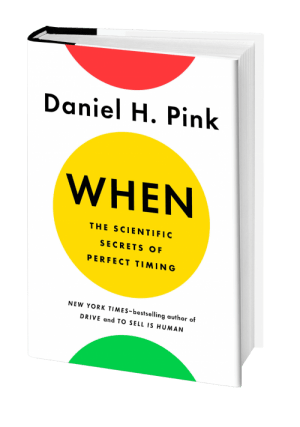
Daniel Pink’s “When” (Part 2)

when-3d-e1511881329973

With a huge earthquake interrupting the end of the school year, we did not get to discuss the second half of the book together. Pink’s ideas have been creeping into our conversations.

Reading the book as a group was powerful and it is something that we will try to do every year as a leadership team and among faculty. It is good to have a book to start conversations and get us thinking about innovation and forces us to take a fresh look at how we do things.

I just finished Part Two: Beginnings, Endings and In Between and wanted to put my thoughts down in writing before they are lost over the summer. The book has slowed down a bit, but there are still lots of interesting points.

  • Beginnings – Centers of Disease Control and Academy of Pediatrics recommend that middle school and high school not to start before 8:30 AM because adolescents need to sleep in the morning. The physical and mental effects of an early start are dramatic on the well-being and performance of teenagers.
  • U Curve of Happiness – Humans have a u-shaped curve of happiness, with a low point being between 50-53 (my current age) and then rising back up to where you were when you were a child.
  • Studies show the more spent on the wedding and engagement ring, the higher the rate of divorce. This could be that richer people can divorce and poorer people sometimes stay together for economic reasons. (my thought)
  • Find fresh starts, like start of month or week, anniversaries, etc. to spur productivity.
  • “uh-oh effect” – When teams reach the half-way point of a project, they feel a sense of urgency to get things done and the most creative portion of the process occurs then. Teams will go for a long time without anything creative and then at the midpoint, bam!, the magic happens.
  • Life is in three sections: 0-30 growing up / 30-60 – people are forging relationships that will help in the future /  from 60-90, people prune the peripheral friends and seek out only emotionally meaningful relationships and experiences; time is limited so they live in the here and now.
  • people like elevated endings, so if you have bad news and good news to deliver, give them the bad news first and good news second;
  • poignancy is a great word and emotion; it means an event or experience with a mix of sadness and happiness; this is especially true at the end of the year or graduation;