
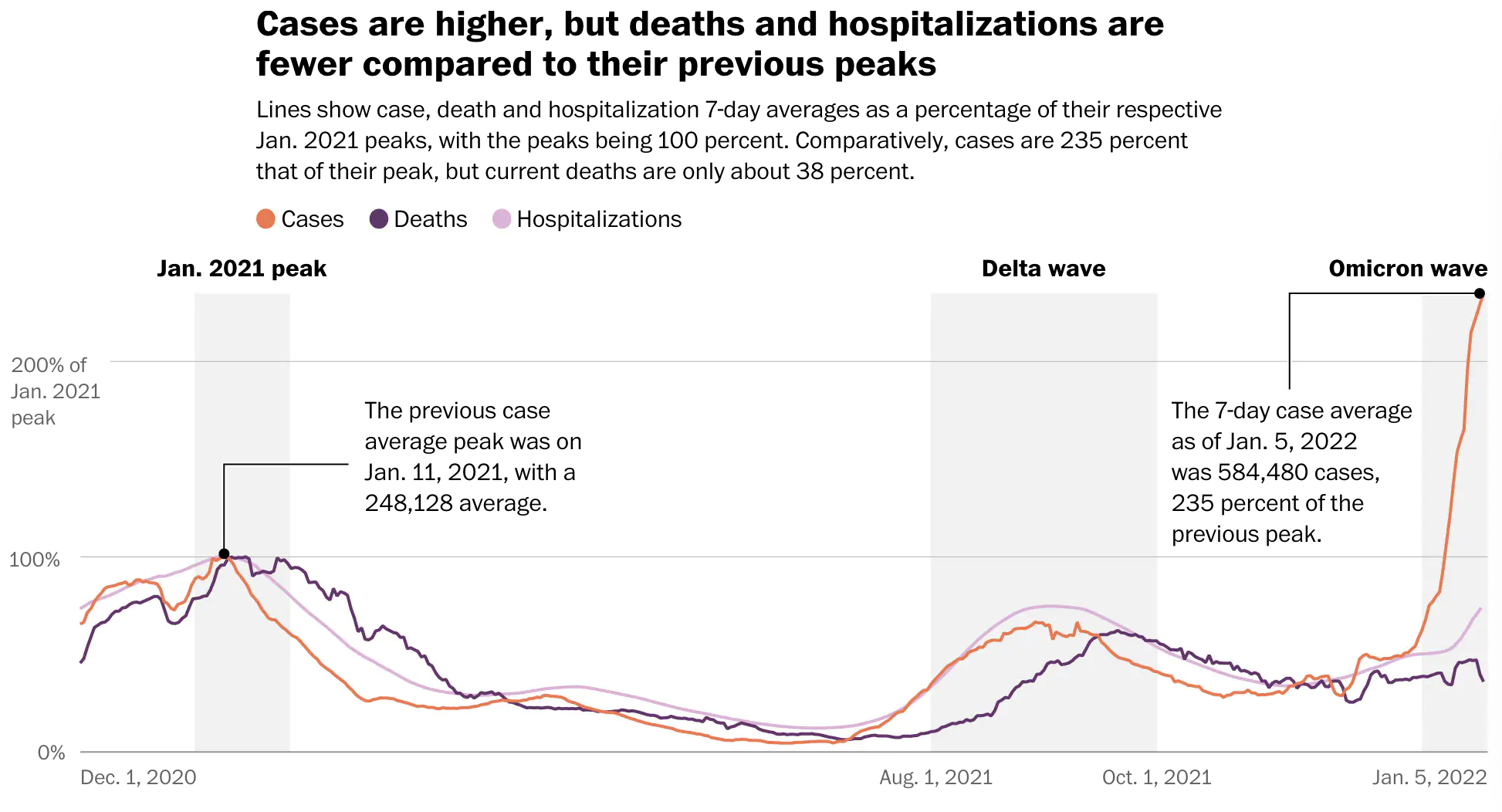
Omicron Wave Data

Courtesy of the Washington Post – January 8, 2022

The Washington Post is doing excellent reporting of the pandemic and providing free access to articles concerning the pandemic. I’ve been disappointed by the sensationalist headlines of the New York Times during the pandemic. They misinform readers about the severity of the variants. In the chart above from this week’s Washington Post, you can see that although cases are at an all-time high in the USA, the number of hospitalizations and deaths are not. I interpret this as vaccines and boosters providing protection and perhaps the Omicron variant is not as severe as previous versions of the coronavirus.

The Washington Post also included another article from CDC in their weekly COVID news summary showing that children should get vaccinated as it does provide the same protection against hospitalization as in adults (see article at the end of this post). I also wonder about how seasonal influenza combines with coronavirus this winter. My takeaway from both these articles is thinking about how schools manage cases in light of a higher number of cases due to Omicron, but a similar rate of hospitalizations and deaths. I see that vaccinated people and young people are much safer in the pandemic than unvaccinated people, older people and those with health risks. Do we need to tighten our protocols? Do we need to go Virtual for a few weeks while the Omicron wave goes through our community? The data from South Africa is showing that the wave is much shorter in duration than previous waves (see chart below).

Washington Post – January 8, 2022

We don’t fully understand why pediatric hospitalizations are up, CDC director says, but vaccination clearly keeps kids safe

Washington Post, Francis Stead Sellers,

The omicron variant, which is sending U.S. children to hospitals in record numbers, is keeping people guessing — even the scientists at the Centers for Disease Control and Prevention, according to the agency’s director.We are still learning more about the severity of omicron in children,” CDC Director Rochelle Walensky told reporters Friday, noting that the increase in hospitalizations is occurring among all age groups.Rates are higher than before among pediatric populations. As of Jan. 1, the rate in the 4-or-younger age group was 4.3 per 100,000. Among those ages 5 to 17, the rate was 1.1. While concerning, the pediatric numbers are still minimal compared with older people: For those over 65, the rate is 14.7 per 100,000.The new variant is rampaging through the United States during the winter months, when other respiratory diseases, including influenza and respiratory syncytial virus, or RSV, are prevalent. Some children are being affected by the two viruses at the same time, making it hard to assess the severity of omicron. Others, who come to hospitals for elective surgery, test positive for the coronavirus but are completely asymptomatic, further confounding the picture.The increases in child hospitalizations could also stem from there being more opportunities to catch the highly contagious omicron variant or from children’s lower vaccination rates.Despite such uncertainty, the CDC director presented compelling data for the efficacy of vaccination:

  • Just 50 percent of children ages 12 to 17 are fully vaccinated and only 6 percent of those ages 5 to 11 are fully vaccinated.
  • The rate of covid-19-associated hospitalizations in unvaccinated adolescents ages 12 to 17 is about 11 times higher than fully vaccinated adolescents of the same age range.

The best way to protect young children who are not yet eligible for vaccines, Walensky said, is to surround them with immunized family members, caregivers and teachers.

My Latest Thinking on the Pandemic: January 4, 2021

Sam Harris is an American philosopher, neuroscientist, author, public intellectual and most importantly for this blog post, a podcast host. His Making Sense podcast is available via subscription from occasionally he makes some episodes open to the public. Sam’s December 14 conversation with Yale professor, Nikolas Christakis, “What Have We Learned from the Pandemic?” is available to the public. I read Christakis’s book, Apollo’s Arrow at this time last year. The 3-hour podcast is a kind of “State of the Pandemic” conversation as we near the end of the second full year of the COVID global pandemic. Christakis believes the first patient contracted the new coronavirus around October 1, 2019 and the first person carrying the virus left Wuhan around November 1, 2019. The TIS Academic Council started planning for the pandemic on January 22, 2020 and the first case arrived to Tashkent during Spring Break in March of 2020. The long podcast covers a lot of ground including breaking down the recently released shorter quarantine and isolation guidelines from the CDC.

Automobile Airbags are a Good Metaphor for COVID Vaccines (image courtesy of ExtremeTech.com)

As Sam Harris says, how much proof do vaccine skeptics need with billions of humans vaccinated without problems? This was the first time I heard that probably everyone will be contracting COVID eventually. I chose the low probability of a vaccine reaction versus getting COVID without a vaccine. Christakis compares vaccines to an automobile airbag; the vaccine does not guarantee you will not contract and/or die from the coronavirus, but it does greatly improve your chances of survival. The same goes for airbags which are standard issue in most vehicles sold.

It frustrates me that so many people around the world refuse to get vaccinated. The latest variant Omicron is partially a result of the virus being able to spread in unvaccinated populations. Viruses usually mutate to a more highly contagious and milder form as a survival advantage. If a virus rapidly kills its host, it usually will not be able to spread. A milder, more contagious form of a virus can survive for longer. However, after watching HBO’s excellent, “Station Eleven“, I fear a future mutation might be deadlier.

WHO Uzbekistan Vaccination Data

According to the WHO, over 33 million vaccine doses have been administered here in Uzbekistan and over 16 million people out of a total population of 34 million have at least one dose. As with many countries, getting accurate data is difficult and all COVID statistics in Central Asia are vastly under reported. I think the vaccination data is more accurate than cases, hospitalizations and deaths data because of the WHO’s COVAX program and its network of public health officials working with local Sanitary Epidemilogical Stations.

One of my big lessons from the pandemic has been that people react very differently to the same conditions. This has made the pandemic the most difficult time for international school educational leaders around the world. However the pandemic progressed and whatever measures schools took to protect employees and students, there is always a portion of the community in disagreement. Atlantic journalist and podcaster, Derek Thompson is an insightful voice on the American and international media. He describes the division between people and media regarding their view of the pandemic in this conversation on the Bill Simmon’s sports podcast. I think he is correct in his analysis of the two “teams” in different phases of the pandemic (table below). I remember some teachers not feeling safe enough to stay in Uzbekistan versus teachers wanting to stay on campus. The next phase of the pandemic revealed the difference between locals and expatriates regarding their receptiveness to vaccines. We are now onto the third phase and people take a range of precautions in their daily lives.

Pandemic Phase 1Team PandemicTeam Flu
Pandemic Phase 2Team VaccineTeam Anti-vaccine
Pandemic Phase 3(Team very cautious) vs. (Team Get Along with my Life)Team Anti-vaccine

We will be issuing our latest TIS protocols this week. I can’t believe that this is the third academic year that is impacted by the pandemic. We managed to have almost a restriction-free 2021-2022 so far. 100% of the classes were held on-campus for all 78 school days so far. We even managed to hold cocurricular activities with our first interscholastic soccer, volleyball and basketball games. We also held our first music and theater productions to live audiences of parents and students. We had our first full faculty professional development sessions and social gatherings. The only aspect missing is international travel and exchanges. I am appreciative of the efforts of everyone, employees, students and parents to make this possible.

What will the winter and spring of 2022 bring to TIS? The evidence from Europe, South Africa and the Americas is showing that we will eventually have a huge spike in mild cases. Derek Thompson describes the Omicron variant like an invader of a castle. It is able to get over the moat and castle wall (vaccine-induced immunity) but the knights crush the invader inside the castle walls (mild symptoms). I am not sure how we will handle a large number of mild cases. The CDC has given us guidance to halve the length of quarantine and isolation (10 days reduced to 5 days). An option for schools will be week-long grade-level or school-level quarantines and providing Virtual Learning. We may choose to press on with on-campus teaching and learning, knowing that most cases are mild to moderate and significant percentage of our community will be home on 5-day intervals. I am waiting to see how long the omicron variant wave lasts, which will also factor in our decision-making. One wild card will be the Uzbek government and their mandates. TIS will be using more rapid antigen tests, following the reduced quarantine/isolation guidelines of the CDC and continuing with masking/ventilation/distancing.