
Last week we went on a tour of less visited monuments/memorials as part of the Leadership Possibilities and Paradoxes project hosted by the US State Department’s Office of Overseas Schools. We had an insightful tour guide, a former federal prosecutor, lawyer, and history buff who gave us the context and history of each monument. This morning we had a reflective conversation about the meaning of monuments of great leaders in our society led by a professor from St. John’s College. St. John’s is known for its Great Books curriculum so John was an expert discussion leader.

The Lyndon B. Johnson Memorial Grove is the bank of the Potomac River and is rarely visited. This spot was chosen because LBJ and his wife enjoyed relaxing there as it looked over the city. It made me think about how my wife Nadia is always there for me. Leadership can be stressful and emotional draining and it is important to have a supportive spouse or partner. LBJ had a tough time (1963-1969) because of taking over from President Kennedy and the on-going Vietnam War. Reading his biography, I was impressed with his accomplishments and his idea of the “Great Society”. He created Medicare and Medicaid, established federal loans for university students, and two important Civil Rights Acts. I can imagine him and his wife talking about a tough day in the White House and looking across the Potomac over the beautiful city of DC.


The Franklin D. Roosevelt Memorial is more visited and more prominent in the city. He is the longest-served president, 12 years from 1933 to 1945. The monument has four “rooms” that cover each of his four terms. In reading his quotes and thinking about his accomplishments, the Democratic Party needs another FDR today! Someone who strongly advocates for marginalized populations (poor, immigrants, elderly, etc.) He also had a strong spouse and his wife is also featured with a statue, the only First Lady to have this honor.
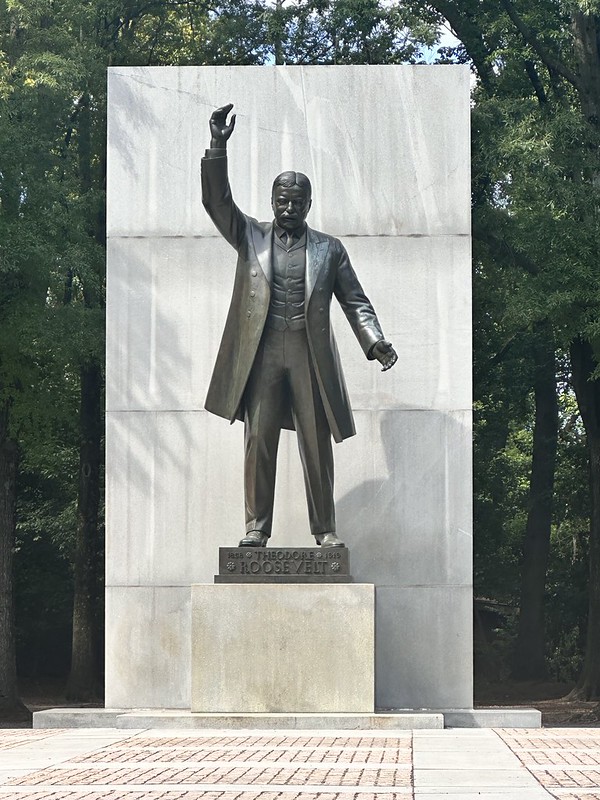

The final monument was his cousin, Teddy Roosevelt Island. I have not read much about him and only know that he was a driving force behind the National Park System. I learned he was the youngest president, elected at age 42.
Some of the major ideas discussed by our group after the tour were as follows:
- John felt that no monuments should be taken down or changed as they are history. People today are taking down some statues and monuments because the values have changed since the monuments were reflected, for example Civil War Confederate heroes in the US South.
- One school leader thought it could be viewed as selfish, previous generations dictating to future generations what was important and to keep them forever.

 TIS Director's Blog
Published by