
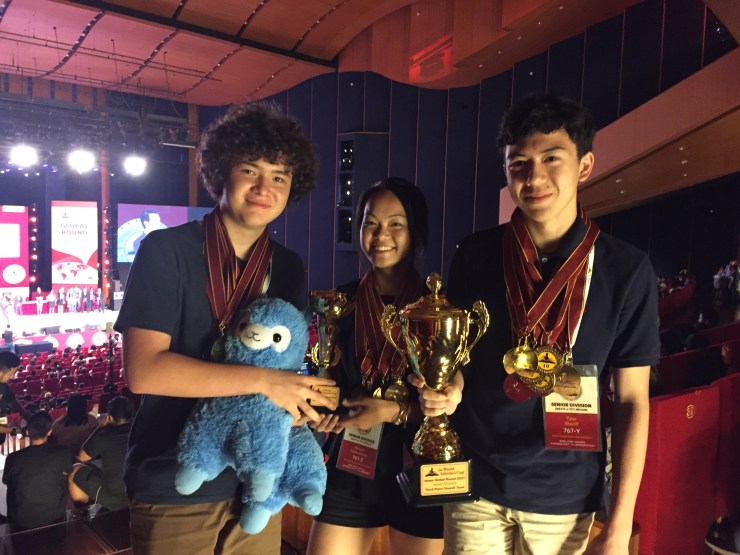
SOIS Shines at World Scholar’s Cup Global Round

30 SOIS students traveled to Hanoi, Vietnam this summer to participate in the World Scholar’s Cup Global Round. The goals of World Scholar’s Cup to motivate students of all backgrounds to discover new strengths and practice new skills and to inspire a global community of future scholars and leaders. The event is a celebration of learning centered around 4 academic events, including debate, knowledge bowl, collaborative writing, and a challenge test. Included in between these are social events to get students to make connections with others. More than 3000 students from over 50 countries were in Hanoi. All of the students had to qualify for the round through local events.
All of the SOIS students did well, making many friends and learning much about themselves and the topics of this year’s event. Several students placed very high in the standings, considering the over 1,000 teams in the two divisions. Grade 9 Emily Yoo finished 44th overall in the junior division. The team of Tyus Sheriff (4th overall), Skye Inada (30th place) and Minami Matsushima (43rd place) won third place in the senior division. SIS English teacher Steve Sheriff won the Coach of the Year prize for his efforts in building the program at our school. Congratulations to all the students and teacher involved in the program!

A delegation of 15 SOIS students qualified for the Tournament of Champions, the ultimate World Scholar’s Cup event in November at Yale University in New Haven, Connecticut, USA.
Students ages 11 to 18 are eligible to participate in WSC. OIS will begin organizing teams for the spring and summer events in the new year. Stay tuned for details.
SOIS Music to be featured @ Kita Senri Station
Everyone is invited to attend the concert on Tuesday, October 24 at 4:00 PM at the Kita Senri station.
SOIS Triathletes Successful in Suita

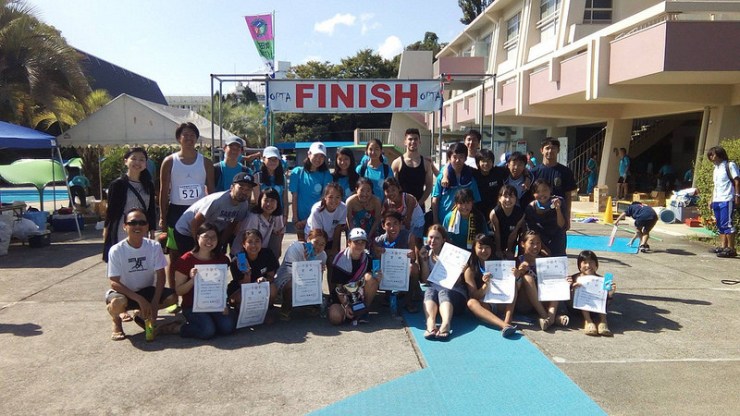
The SOIS Running/Triathalon team participated in the Suita City Mayor’s Cup Triathalon on Saturday, September 3. The race included a 750-meter swim, 20-kilometer stationary bike ride and a 5.6 run in the beautiful Kita Senri park, located near our school. OIS senior Leola Hara (pictured above) won the women’s category and will be able to keep the Mayor’s Cup for one year.
All OIS middle school and high school students are invited to join team. The team has practices Monday, Tuesday, Wednesday, and Friday. Students participate when they can and are eligible to participate in any of the events. The schedule for this fall season is as follows:
Rinku Bayside 10km/5km run – Sunday, September 24, 2017 (park located near Kansai International Airport)
Nagai Stadium Run – 10km, Sunday, October 1 (home of Cerezo Osaka J-League professional soccer team)
Katsuoji Long Run – 9:00 AM Saturday, October 14 (a non-competitive run to the famous temple in the Minoh hills)
AISA Cross Country Race – October 20-21 (High school race in Seoul, South Korea)
For more information about the club, please see coaches Tara Cheney or Hisashi Munemasa. Go Sabers!
Class of 2017 Finishes In Style
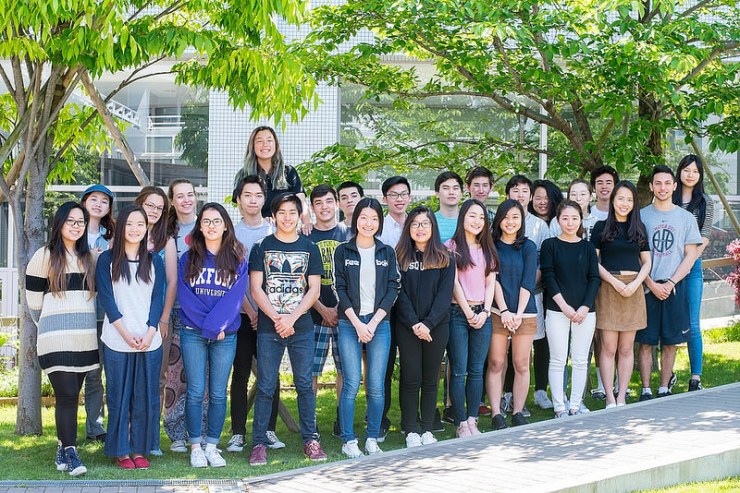
International Baccalaureate Diploma Programme (IBDP) students receive their exams results on July 6 (IB Results Day). Many have conditional offers from universities and their admission depends on reaching a specified score on the exams. IB Results Day sometimes can determine their future path. The OIS class of 2017 scores from the May 2017 were outstanding, with an average score of 33.3 compared to a world average score of 30. A student needs 24 points to pass the exam out of a possible 45 points. Of the close to 150,000 students sitting the over 500,000 exams, only 200 students had a perfect score of 45.
The OIS class of 2017 scores from the May 2017 were outstanding, with an average score of 33.3 compared to a world average score of 30. A student needs 24 points to pass the exam out of a possible 45 points. Of the 159,400 students sitting the over 500,000 exams, only 218 students reached a perfect score of 45. In fact, only 5% of IB candidates score 40 or above. Kai Junge, Airi Wakasa and Corrine Watanabe scored over 40 points, which is 16% of this year’s class. Kai scored perfect 7s in his higher level science and mathematics course, a first for OIS. All OIS students taking the full diploma programme scored 25 or above.
Most of the students this month are off to their universities to begin the next step of their academic career. The students weighed the offers this summer, some after receiving their IB scores. Students will be matriculating in the following universities next year:
North America: Pennsylvania State University, University of Illinois at Urbana-Champaign, Luther College (Iowa), Emily Carr University of Art & Design (Vancouver, Canada), Savannah College of Art and Design, University of British Columbia, University of Alberta, University of the Pacific (California), University of California- Santa Barbara, Chapman University (California) and University of Hawaii at Manoa.
Eurasia / UK: London College of Fashion – University of the Arts, University of Cambridge, University of East Anglia and Nottingham Trent University, Holland IES and Institute of Economics & Finance (Mongolia) and Disciple Training School, Youth With A Mission, Herrnhut, Germany.
Japan: Kwansei Gakuin University, Ritsumeikan Asia Pacific University, Temple University, Osaka University, Keio University and International Christian University.
Congratulations to the Diploma Programme teachers, Counselor Melissa Lemug and especially, to our graduates of the Class of 2017!
Assessment & Student Achievement
I spent much of my time this summer reading and thinking about the relationship between assessment and student achievement. It was part of my doctoral studies and the assignment helped me become more familiar with educational research and academic writing. My takeaways from a month of research are as follows:
- Formative assessment and feedback are so important to student learning. We do not help teachers enough with these skills. Frequent, specific, interactive feedback between student and teacher during the learning process improves student achievement. Leaders inside education and the public, focus more on summative assessment because it is documented and easier to see results. I want our faculty to be talking more about better ways to provide feedback to students.
- I am really interested in “value-added” statistics of teachers. This is the idea that the effect of a teacher on a group of students can be isolated from other factors and can be measured through standardized tests. I think a simple way to improve education is to get smarter people to become teachers, however, with such low salaries and status in my countries, including my own of America, it is a challenge to get the best university students to go into education. You can also recognize and reward current great teachers, and retrain and support or counsel out of teaching, underperforming teachers. Combined with classroom observations, a value-added number can help leaders identify people who need help.
- It was fascinating reading the research of the assessment for accountability movement in the USA. Holding teachers and principals responsible for their students lack of growth, has had a big impact on the morale of faculty. The data shows growth in mathematics for students close to the proficiency level or underachieving students and no improvement in reading levels. A broader range of assessments and more support for families is the direction schools should be going.
Below you can read my review of the current literature. =
International Education Policy

Today I completed an intensive, 8-day course in International Education Policy at Lehigh University as part of my doctoral program. The class focused on tools researchers use to analyze policy. In my job as head of school, I deal with policies coming from the international, national and school levels, either implementing or making them. The course gave me a new perspective on the importance of policy in education. It was my first class in the Comparative International Education (CIE) department. From Lehigh University’s website. The class had a good mix of researchers, teachers and NGO employees.
Graduates completing their degree in the CIE program may move into positions as government officials and education policy makers, research/policy institute scientists, development program officers, or work in various non-governmental and educational organizations either in the United States or in countries around the world.
The culminating project for the eight days was a policy analysis. I chose the adoption of the International Baccalaureate Diploma Program (IBDP) by government schools in Japan. The Ministry of Education, Culture, Sports and Technology (MEXT) set a goal of 200 local schools to be authorized the IBDP by 2018. I read many reports and looked at data to come up with my recommendations. I am indebted to Dr. Beverly Yamamoto of Osaka University and her work with the IB and MEXT. You can read her full research report. I would also like to thank Dr. Emily Anderson of Centenary University who taught the course and my classmates. You can read my case study analysis below.
Read the June issue of Tango online!
Tango is the voice of the SOIS students!
Read Educator Online!
The June 2017 of OIS Educator is available for reading and download.
The International School Surge

Alan Wechsler wrote an excellent article about international schools earlier this month in The Atlantic. The International School Surge: Increased demand for a “western” education around the world has reshaped whom these institutions serve. The piece gives a great overview of the pros and cons of international education and how it fits in with the global economy.
The photo above captures a bit of international school culture. I hosted a BBQ for the school elementary baseball team after a parent-student game to culminate the season. In the photo are citizens from six different countries.
I have worked in international schools since 1992. I have seen the growth of the number of schools and the switch to local families instead expatriates enrolling in them. When I started there were around 1,000 international schools, today there are over 8,000 and it is expected to grow to 16,000 in the next ten years. That is good for my future job prospects! Locals now make up 80% of the student population. Driving the demand are two factors. First is the quality of higher education in the USA and other western countries. Rich people want to send their children to the best universities in the world. They also want fluent English, which has become the world’s language of commerce and culture. My third culture kids (TCK) have more in common with international school students throughout the world than they do with students in my home of Northern Michigan.
All of these international students taking up spaces in American universities does have some downsides. They take spaces from US students and create competition for jobs afterward. Researcher Monica Gallego Rude points out in the article that this system is increasing inequality in the world, with a small group of rich families paying for access to the English-speaking global economy while most of the world does not have this access. Tuition can be quite high in international schools. Our tuition is over $20,000 US per year.
I am really interested in the future of international education and where it is headed.
 TIS Director's Blog