Haese Mathematics Visits SOIS

33140752076_7104e239b9_z
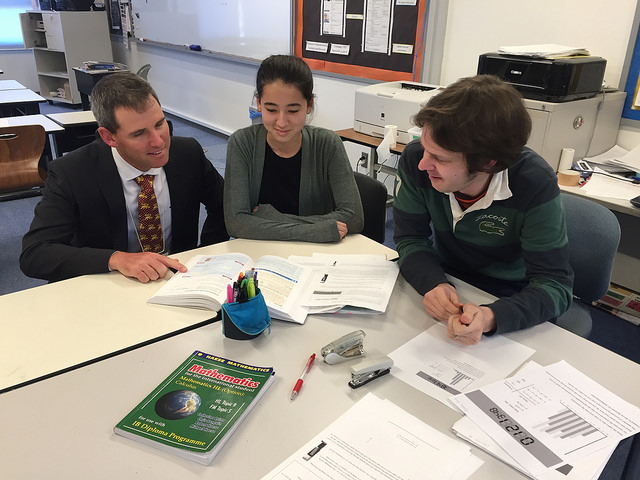
Dr. Michael Haese and Mr. Bertman with a grade 9 student Lilian

Dr. Michael Haese from Haese Mathematics spent yesterday afternoon with some of our students and teachers. Haese Mathematics is an Australian textbook publishing company. Dr. Haese has written what many consider (me included) the best textbooks for the MYP and DP mathematics curricula.

I had a chance to talk with OIS mathematics teacher Mr. Kevin Bertman and Dr. Haese about mathematics teaching and learning. Both gentlemen believe that mathematics differs from the other IB subject areas in that there needs to be a balance between direct instruction and inquiry. Students as they are progressing through the PYP and MYP, need mathematics fundamentals. This involves direct, teacher-driven instruction and rote learning. This will give students a base of facts and processes that they can use to inquiry later on in their use of mathematics. Too much inquiry or justifying why mathematics must be learned or how it relates to their lives, takes time away from learning fundamentals. Of course, inquiry is essential, but limited in its use. The Haese Mathematics textbooks take this into account by each chapter including some example of where a particular math concept is encountered in our daily lives. However, there are also examples of problems and solution and practice sets of problems. Subjects other than math in the IB can have more inquiry which the IB encourages.

We discussed the state of mathematics education throughout the world. In our region of East Asia, students from Japan, Korea, China and Singapore dominate mathematics competitions. This stems from their style of education, including night “cram schools” (juku in Japanese) like Kumon that are devoted to a rote style of learning, including mathematics. It says something that they dominate standardized tests and competitions, including our AISA mathematics competition. Direct instruction works in learning mathematics.

The conversation inspired me support our mathematics curriculum at OIS. The elementary faculty has been working hard at developing a mathematics curriculum in the PYP. I think Dr. Haese or someone similar, working with our secondary mathematics teachers, could really help this initiative. Elementary teachers are asked to be specialists in many fields, which is unfair, and need the support of educators devoted to mathematics.

After seeing Dr. Haese’s books in three of my international schools, it was a pleasure meeting him and put a face to the name on the cover of the books. He is a dynamic educator, passionate about mathematics education. I highly recommend his textbooks and I hope to have him come back sometime.


OIS “Aces” the 2016 PSAT

31776133793_6141b765fd_z
Grade 10 students in biology class

Students and parents today are much more anxious of standardized test scores and the college admissions process than when I was in high school 30 years ago. I think part of it is that with the globalization of the economy and rise of the internet, it is a much more competitive job market which makes families concerned about their children’s future success. Based on the recent results of our OIS high school students, OIS parents can rest assured that their children are on track for university and career success.

The faculty and students are analyzing the scores of the Preliminary Scholastic Aptitude Test (PSAT). Students in grades 10 and 11 completed the exam in October and the scores came back to us earlier this month. Half of the 24 OIS students who took the test scored at or above the 90th percentile. 2/3 of the students scored above the 80th percentile. A score above the 90th percentile means a student score higher than 90% of the students in his/her grade that took the test.

The PSAT is used to prepare students for the SAT, which many universities in North America and throughout the world use for determining admission. It is an accurate predictor of what the student will score on the SAT and it also gives the strengths and weaknesses of students on the test. We highly recommend students to do extra preparation for the SAT. Counselor Melissa Lamug and our testing coordinator, John Van Plantinga can give students guidance in this area and are working with them to understand their score reports.

This is the second year of the revised SAT and PSAT. The ACT has surpassed the SAT as the most popular admissions test. College Board, the publishers of the SAT reacted to this by making its test more like the ACT. OIS is a testing center for both the SAT and ACT and offers the test throughout the year for our students. We host the SAT 6 times per year in October, November, December, January, May and June. We host the ACT 4 times per year, in September, October, December and April.

Three grade 11 OIS students scored in the 99th percentile of the exam. Congratulations to Kaya Friese, Mark Yamamoto and Nicole Yoo! (pictured below)  American citizens scoring that high are eligible for the National Merit Scholarship.

32647597311_bce0043570_z
Kaya, Nicole and Mark 


My Day as a Tenth Grader

32485569842_3d183f716f_z
Students discuss Boko Haran’s influence over Africa

I was inspired to follow the students for a day by a blog post I read about in the Washington Post.  Alexis Wiggins taught in international schools in Malaysia and Qatar and is the daughter of a well known educational consultant, Grant Wiggins. She shadowed a grade 10 class one day and a grade 12 class the next, completing all the same work and participating in all activities and she blogged about it on her father’s website. It was picked up by the Washington Post and read around the world. After her experience, she concluded the following:

  • students sit all day long which is exhausting;
  • teachers did most of the talking and were more active than the students, who were passive listeners;
  • she felt the students were treated as a nuisance, and were told to be quiet and pay attention often;
  • Alexis also noticed some sarcasm used teachers and she felt guilty of this too at times and wanted it eliminated from schools.

I reached different conclusions than she did, perhaps it was the particular day or time of the year. Maybe it was our IB curriculum. I am not judging her schools, because her points are valid and there is some of that at every school, including our school. However, my day went by fast! As the head of school, I am removed from the classroom, working on projects and issues not directly involved in the daily life of the students and teachers. It was so good for me to get back in touch with the students and teachers and get an appreciation of what their days are like. I think it would be good for them to follow me around for a day to see it from my perspective as well!

32485570202_c6149294c1_z
Student help each other in mathematics class. 

The grade 10 schedule yesterday was Japanese, humanities, chemistry, lunch, mathematics, visual arts and music or physical education. Here are my takeaways from the day:

  1. Students were mostly working independently on projects or assignments. Teachers briefly introduced topics at the start of class and spent a lot of time going around the classroom, meeting with individual students. They would occasionally call the class’s attention to explain an idea or solve a problem. Most of the time, students could get on with their work like in an office environment. This allows for much differentiation, and as in any class, students have a wide range of ability and interests. Example – In humanities they were preparing for the upcoming Model United Nations and each student was working on a 30-second opening speech to the general assembly and a thorough, detailed report on a country they chose and were representing at the conference. Students could choose from topics like universal education, the death penalty, doping in sports, poaching/ivory trade, etc. One student was looking up the verb “to hinge” while simultaneously another was reading a Fiji government report on education funding. That was much better than the entire class listening to a lecture each of the topics.
  2. Students are not only learners, but teachers as well! There were so many instances of students helping each other. I overhead a discussion  between students on the role of Boko Haran in Nigeria, or listening to another student explaining how to calculate the molar mass of a complex compound to her neighbor in chemistry. You really learn something well when you have to explain it to someone else. All of us at OIS, students, teachers and parents are both learners and teachers.
  3. Classroom management is easier at OIS than other parts of the world. Teachers rarely had to deal with disruptive or off-task behavior. The students largely were trying their best and engaged in the material. I thought in mathematics class, with a worksheet of a large number problems of increasing difficulty, that students’ attention would wander. I didn’t notice this and they were asking lots of questions to Mr. Bertman and each other and moving through the set at a good pace. We do have mischievous, restless students, especially in elementary and the challenging time of early adolescence, middle school, but I didn’t see a single instance of annoyance or anger from a faculty member. Of course, my presence may have influenced the students, but not for an entire day. I sense that students in Japan, our school included, are not as rebellious and have a deeper respect for teachers and education. The challenge with many of our classes is to solicit strong opinions and innovative ideas, especially during class discussions. I worked in Latin America, Australia, Eastern Europe and the United States, so have experience of students from a variety of backgrounds.
  4. The fine arts are more important than traditional academic classes. Well, maybe not more important, but as important. Finishing the day sketching a still life object with charcoal and singing in the choir were so pleasurable to me. The arts make us more human and it is so nice because of our shared program, music and visual arts are central to our identity and all students enroll in these classes. I regret not taking  an art class after grade 9 and not playing a musical instrument in secondary school. My commitment to supporting music, visual arts, theatre, dance, physical education was reinforced through this experience. Mathematics, writing, reading, understanding history, speaking other languages, etc. are all important, but often in schools the fine arts are subordinated to these core subjects. They should be on equal footing.

I would like to thank the grade 10 students and teachers for putting up with me for the day.

31795724714_78343df820_z
Grade 1o spent the afternoon with the fine arts. 

Great Food and Conversation!

32435284862_03562c09d2_z

Everyone in attendance had a pleasurable evening on Friday at the Russian Cultural Celebration. OIS Russian families and Osaka University Russian professors and students shared their family recipes and experiences on all things Russian. We learned how to make pelmeni (dumplings), blinchiki (crepes) and sampled many desserts and tea from a samovar. OIS parents Ana Yurieva and Liliya Sova should open a Russian restaurant here in Osaka! Delicious! We made a lot of food but it was all gone by the end the night.

Dr. Sachiko Horii Yokai, OIS parent and Osaka University professor of Russian language, used Nobel laureate Svetlana Alexievich’s Second Hand Time: The Last of the Soviets to lead our discussion on identity today in Russia. With Trump and Putin in the news so much lately, it was easy to have a stimulating exchange of ideas. It inspired us to make a trip to nearby Vladivostok, a short flight away from Osaka.

On behalf of OIS I would like to thank everyone who participated, it was a delightful evening! We feel it is important to learn about all the different cultures in our school community and cooking always seems to bring people together. The next cultural evening is tentatively scheduled for Thursday March 4. We will be featuring Egyptian and Saudi Arabian cuisine.

31776181853_0180eb8245
Ana and Sachiko prepare a Russian Beet & Potato Salad