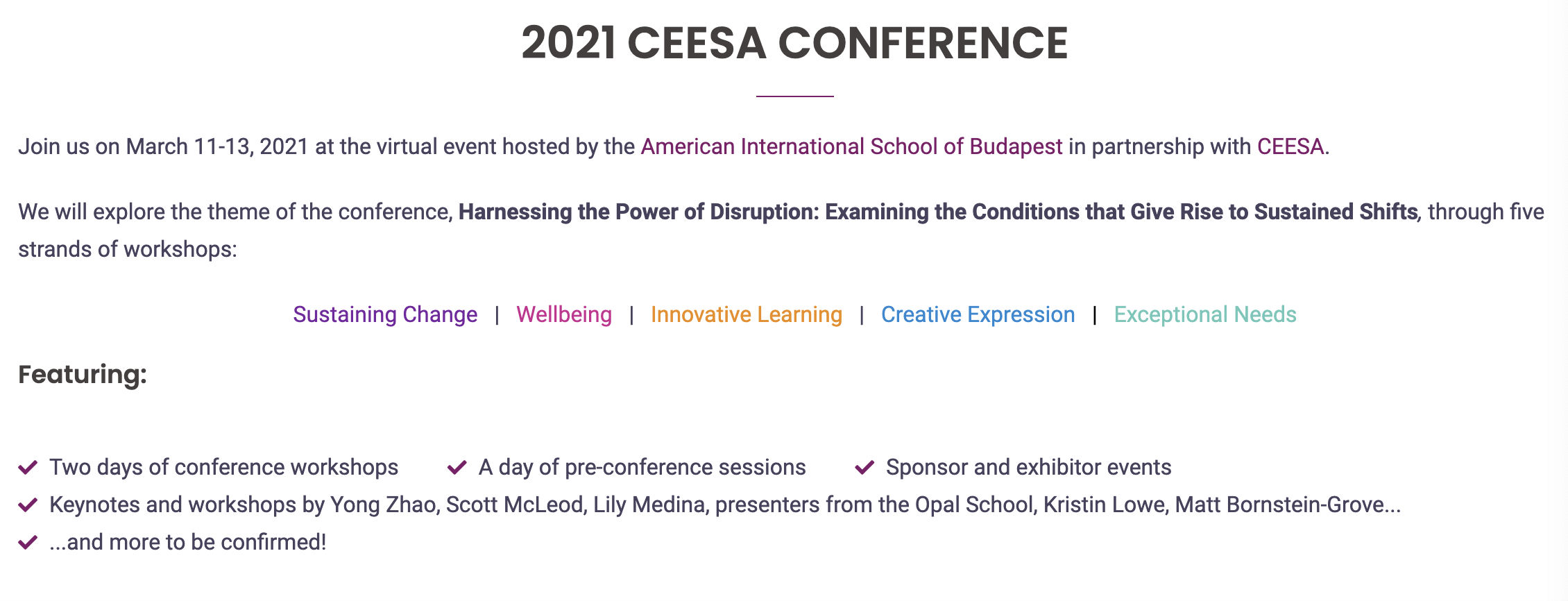
Teacher professional development around the world is still mostly online and in our Central & Eastern Europe Schools Association region is not an exception. Below is the announcement of the 2021 CEESA Virtual Conference that is hosted by the American International School of Budapest from March 11-13, 2021. Harnessing the Power of Disruption is the theme. The pandemic certainly has disrupted everything that schools do. This major disruption has given all of us carte blanche to remake teaching and learning.
COVID News & Opinion

Covid-19 patients who recovered from the disease still have robust immunity from the coronavirus eight months after infection, according to a new study. The result is an encouraging sign that the authors interpret to mean immunity to the virus probably lasts for many years, and it should alleviate fears that the covid-19 vaccine would require repeated booster shots to protect against the disease and finally get the pandemic under control.
Patel, Neel V. MIT Technology Review January 6, 2021
It is encouraging news coming out of the La Jolla Institute for Immunology in California. The study of 185 recovered patients from COVID show after 8 months, they still have immunity. The research led by Dr. Shane Crotty was published January 6, 2021 in the journal Science.
More good news coming from a survey featured in Scientific American that shows that 63% Americans want to take the vaccine. We need to get 60-90% of the population vaccinated to put the pandemic behind us. There are certain groups that are vaccine skeptical, but I would think most of the TIS community would take the vaccine.
I continue to read reports of COVID cases increasing all over the world. In my home country of the USA, there were more than 4,000 deaths on Thursday. Tokyo, Shijiazhuang, United Kingdom, and other cities and countries are on lockdown because of the spike in cases. I am concerned about if/when the next wave will come to Uzbekistan.
Finally, New Yorker contributor and author, Lawrence Wright was interviewed on NPR’s Fresh Air program on Thursday. He discusses his lengthy piece in a January issue of The New Yorker. The TIS library subscribes to The New Yorker. Below are links to articles I refer to in this blog post.
- “Covid-19 Immunity Likely to Last for Years” MIT Technology Review (January 6, 2021) https://www.technologyreview.com/2021/01/06/1015822/covid-19-immunity-likely-lasts-for-years/
- “The Best Evidence on How to Overcome COVID Vaccine Fears” Scientific American (January 7, 2021) https://www.scientificamerican.com/article/the-best-evidence-for-how-to-overcome-covid-vaccine-fears1/
- “The Plague Year” New Yorker Lawrence Wright (December 28, 2020) https://www.newyorker.com/magazine/2021/01/04/the-plague-year
My Latest Thinking on COVID
The CDC announced last month “acceptable alternatives” to shorten the 14-day quarantine they recommend for all close contacts.
- Alternative #1 – Contacts can reenter the community after Day 10 if no symptoms. The residual post-quarantine risk is estimated to be 1% with an upper limit of 10%.
- Alternative #2 – Contacts can reenter the community after Day 7 if no symptoms and they test negative. The test must be within 48 hours before the planned return (Day 5 or Day 6). The residual post-quarantine risk is estimated to be 5% with an upper limit of 12%.
- Note – With both alternatives, continued symptom monitoring, masking, etc. must take place through Day 14.
I am pleased the CDC reduced the 14-day quarantine because it was quite the burden on families and our school. The increased risks with the two alternatives are low enough in my opinion for us to implement these alternatives as policy. Of course in the case of a major outbreak, we would stick with the 14-day quarantine, but with low transmission in community as it is currently, we could implement the alternatives. I also see this note near the end of the report about people waiving quarantine protocols by showing a high antibody count. The TIS COVID Response Team will seek advice from our medical experts to see if we will implement the new protocols.
Serologic testing: The utility of serologic testing to provide evidence of prior infection that would permit exclusion from quarantine has not been established and is not recommended for this purpose at this time
“Options to Reduce Quarantine for Contacts of Persons with SARS-CoV-2 Infection Using Symptom Monitoring and Diagnostic Testing” December 2, 2020 CDC link
I am concerned about reports from the UK and USA about the new coronavirus mutation. Thankfully, the mutant virus strain is not more lethal, but it may be much more highly infectious, perhaps up to 50-70% more. There are no reports of the strain in Uzbekistan but I would guess genome typing is rare or do not exist here. With more people being infected, more people will die. “The Mutated Virus is a Ticking Time Bomb: There is much we don’t know about the new COVID-19 variant—but everything we know so far suggests a huge danger” by Zeynep Tufekci in The Atlantic discusses the new variant the rollout of vaccines. We will be monitoring the rate of infection closely to see how it impacts our school community.
My Latest REflections on COVID – Exams and Emotions

The Association for the Advancement of International Education in their latest COVID Briefing featured an article in The Economist titled, “The Pandemic has Prompted Questions About High-Stakes Exams: But other ways of assessing students creates new problems”. The article gives an overview on how the closure of schools last spring, wreaked havoc on summative assessments (final exams) all over the world. The annual International Baccalaureate Diploma Programme exams taken each May were cancelled for TIS students. Instead, the students received final grades based on pieces of work submitted through the 2-year programme (IA – internal assessments) and teacher predicted grades. Controversially, the IB also used historical averages from TIS and subject areas to determine final grades. This sparked outrage and the IB raised everyone’s marks instead of fighting the battle.
School systems all of over the world were affected by school closures. The disruption has education experts re-thinking the value of exams and what alternatives are out there. France for example is moving to 40% school work and 60% final exam or many American universities are waiving ACT and SAT (university admissions tests) scores as part of the admission process. The global trend is to put less emphasis on the final exams, but this puts pressure on teachers and last year’s results in England, show evidence of grade inflation. I don’t think the IB this May will cancel exams to avoid the rukus from families. They have shortened exams in some subject areas as a nod to reduced on-campus learning.
I personally think final exams are better than any alternative assessments of students. They motivate students to learn ideas, skills and content. It is an objective measure. I do see the problems of poor schools, rich parents paying for test preparation courses or some students not doing well under pressure. However, I feel it is better than anything else education has come up with yet.
AAIE also shared a Washington Post article and podcast “Remote School is Leaving Children Sad and Angry” describing the emotional toll Virtual Learning takes on some students. TIS has been fortunate to be able to re-open the campus and we just completed our seventh week of learning in person. We hope to continue. I would add that not only is there an emotional toll on students, but also a physical one. Students are less active at home than they are at school. I saw the physical deterioration of my three teenage children during our 88 days of online learning.
Finally, they recommend the book for parents, The Distance Learning Playbook for Parents K-12 by the Cultures of Dignity group.
Liberating Structures to Connect Community Members
Earlier this week, I led the faculty through a workshop using Liberating Structures. The goal was to create connections between faculty by having them practice listening and giving advice to each other in small groups. The pandemic has made everyone a bit anxious and stressed, and rifts may be starting to develop within the faculty and staff. The menu of Liberating Structures are excellent tools for getting people to talk to one another productively. I especially loved the Troika Consulting, in which two colleagues act as consultants for another colleague (client). An excellent side benefit is teachers can use the Liberating Structures techniques with students, and Zoom enhances the experiences. I would like to thank the Association for the Advancement of International Education for introducing our leadership team to this useful resource!
How far Should we Be away from Each Other? My Latest Thinking on the Pandemic and Schools
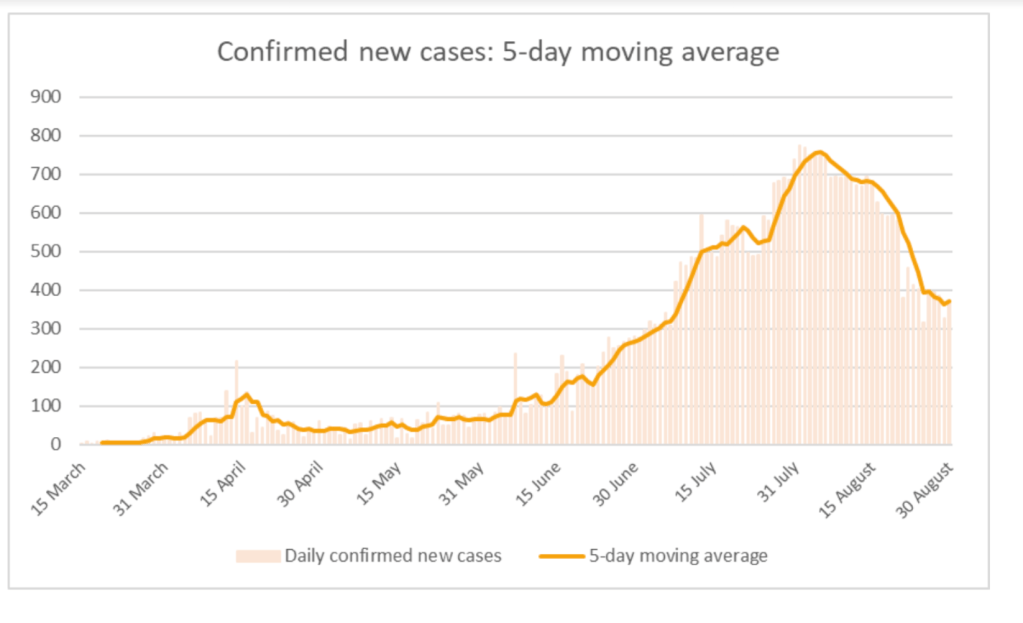
Our leadership team continues to closely monitor the pandemic here in Uzbekistan. Above is the periodic situation report from our friends over at the UN-WHO office here in Tashkent. According to the official statistics, you can see that the number of cases is falling, with a total of 368 cases, 174 in Tashkent city and another 94 in the Tashkent region. There are almost 2400 people being treated in hospitals with 387 in serious condition. The Minister of Health is deploying sanitary experts to help schools open on September 14, and is quoted, “We have no right to turn educational institutions with more than 480,000 teachers and over 6.2 million students into a hotbed of the epidemic”.
AAIE pointed out an excellent medical research website called BMJ. I read with interest the studies of physical distancing. We debated about spacing in classrooms and settled on 1.5 meters distance between desks. There is limited research in the area, with one study showing that infection rates increase by 10.2% (12.8% from 2.6%) with at least a 1 meter distance between subjects. Other studies show that singing, panting from exercise and talking loudly can propel particles 7 to 8 meters. Much also depends on air circulation in a space. One Japanese study showed infections occur 18.7 times more indoors than outdoors. There are few instances of outbreaks on planes, the guess being people are not talking loudly. The article summarizing the research in this area featured the chart below. For schools, the second category “wearing face coverings, contact for prolonged time” is most of what we are working with. As I am seeing more and more, ventilation is key and will allow us to do more.

Covid Mental Health
I listened to Dr. Laura Murray, a psychologist at John Hopkins University discuss mental health issues caused by the pandemic (Covid Mental Health Q & A podcast). My big takeaway was the idea of humans processing the risk of contracting Covid-19 has moved from the acute stage (hurricane) to a chronic stage (car accidents). The mind perceives chronic risk differently that acute risk and we need to be aware of this. Most people when they get into a car do not think, X number of people die or are injured in vehicle accidents every year. For example, my family no longer wipes down all groceries before bringing them into the house. Other takeaways are as follows:
- Use self-disclosure to ease students into talking about their feelings, or perhaps instead of using the word feelings, use “thoughts” instead.
- Students are only being observed/interacting with their parents instead of a variety of adults like teachers and coaches.
- Recent CDC surveys are showing a higher rates of mental health issues during the pandemic and this is natural in these uncertain and stressful times.
Talking Education On Kun.UZ News
I would like to thank Alisher Ruziohunov a reporter for Kunuznews for giving me the opportunity to talk about education in the Uzbekistan media. It is nice not to focus dealing with the Covid-19 pandemic and discuss best practices in education. Here is the transcript from the interview in Uzbek. (https://kun.uz/news/2020/08/23/oqituvchilarning-maoshi-zamonaviy-maktablar-va-pandemiya-toshkentdagi-xalqaro-maktab-direktori-bilan-suhbat)
Video: TIS Campus Updates
NPR’s Advice for School Reopening Plans
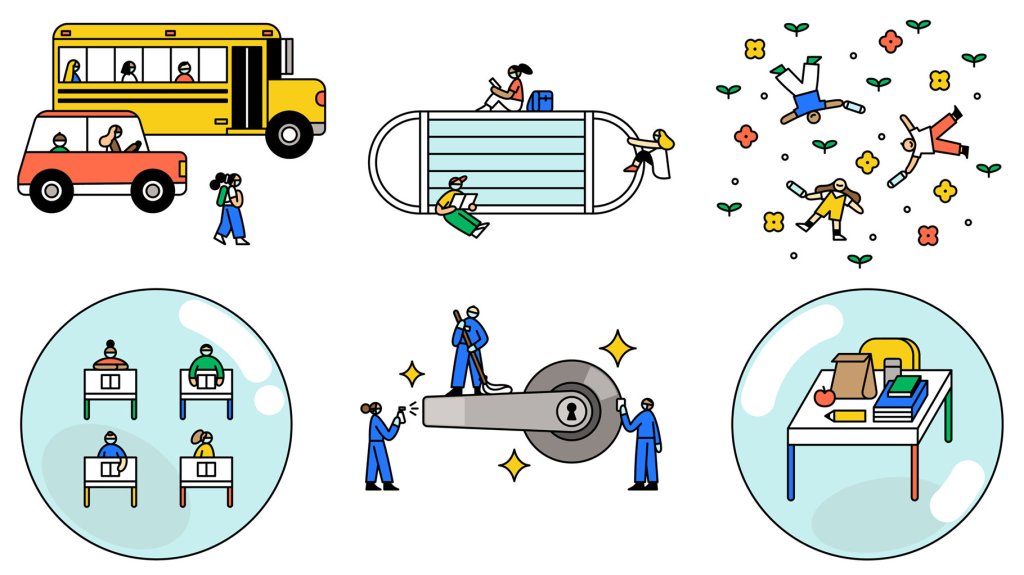
National Public Radio had a comprehensive article for parents on evaluating the risk of sending their children back to school “How Safe Is Your School’s Reopening Plan? Here’s What To Look For.” It also helped clarify and prioritize my thinking on our mitigation of risks if we return to campus.
- Stay At Home If You Are Sick. We need to encourage students and employees to stay at home if they have any symptoms of Covid-19. The CDC does not recommend schools to screen people coming onto campus because it should be the job of the parents to do this. The article also reminds us if the parents are sick, the children should stay home as well. We also need to be more generous with our sick leave for employees. We are building new, air-conditioned entries with temperature-measuring cameras. I believe this is a good reminder for people to stay at home if you have symptoms.
- Masks These must be mandatory for both adults and children. Adults disperse air particles greater than children and studies show adults transmit more to children than vice-versa. CDC does not recommend face shields instead of masks, but does say they can be combined. Schools should schedule “mask-breaks” outside during the day.
- Physical Distancing Schools need to adapt their spaces to maintain a 6-foot (1.8 meters) and it is recommended to hold classes outside and keep cohorts small and in bubbles, isolated from other groups of students. Plexiglass barriers as recommended for reception and high-traffic areas. Their efficacy in the classroom is in doubt because of air flow around them.
- When a student or employee becomes ill. Schools need detailed protocols that include immediate isolation and testing if possible. With or without testing, people need to stay isolated for 10 days from the onset of symptoms. If someone does test positive, contact tracing needs to be done as soon as possible. Establishing stable cohorts or pods is vital to prevent a whole-school shutdown.
- Testing It would be ideal for weekly testing for everyone, but at the moment that is not possible. We can arrange for relatively big numbers of foreigners to be tested at the Tashkent International Clinic with results ready is about 24 hours.
- Air Circulation – Getting fresh air indoors is the solution here, or holding classes outdoors.
- Cafeteria – Staggered lunch times or in-classroom dining are the best practices.
- Outdoors is best. Frequent mask breaks and recess outdoors is the best practice. Non-contact and outdoor sports like cross-country running are advised, contact team sports are not recommended. It is OK to take off masks if athletes are breathing hard, as long as they are distanced and outdoors.
- Disinfecting Surfaces Hand hygiene is the key here, so lots of alcohol-disinfectant dispensers and sinks will be important. The benefit of harsh disinfectants over soap and water is up for debate.
“Schools should focus cleaning efforts on high-touch surfaces like doorknobs, bathroom doors and sink areas multiple times a day. And some opportunities for touching surfaces could be eliminated. “Classroom doors can be left open until class starts so that each student does not need to open the door,” Tan says. Cleaning desks is less of a worry, Miller says, because students don’t touch one another’s desks that often.
It’s important to thoroughly clean bathrooms that children routinely use, says Hewlett. These are high-touch areas and can get crowded. Miller says, “Bathrooms must have strong exhaust fans,” as airflow dilutes virus that may accumulate in the air.”

