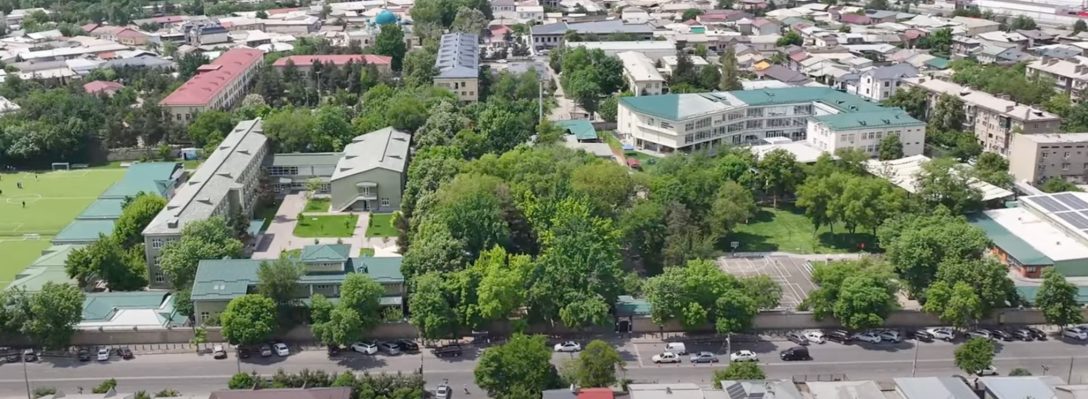
Developing a Nature Trail on Campus

I invited Mrs. Svetlana Jovanović from the Jevremovac Botanical Garden to help us identify some of the trees on the secondary school campus. My idea is to develop the campus as a “living laboratory” that can be used by the science classes of ISB. She identified 34 different species of tree, including my favorite, a Serbian or Pančić Spruce tree, which is native to Serbia and Bosnia. We will now get signs made identify the trees with the scientific, English, and Serbian names. I will ask the science classes to “tell the story” of each of the trees and develop an on line nature trail with photos and information about each tree. Perhaps with the latest technology, the information can be retrieved through smart phones from the sign itself.

I learned of Mrs. Jovanović from her book, which she kindly autographed. She works as a curator at the Jevremovac Botanical Garden. The garden is part of the University of Belgrade’s Botany and Forestry departments and is located in Dorčol district in downtown Belgrade. I’ve visited several times (link here) and have used her excellent guide book to the garden to identify trees in the city. She spent a lot of time identifying the trees, taking leaf samples back to the garden and walking the campus for several days.

In addition to the identification of trees, we have put up bird and owl nests to encourage birds to nest on campus. Dr. Milan Ružić worked with our students on this project as well as giving presentations on Serbia’s nature. I would like to include the Garden Club on this living laboratory project as well. This can be combined with recycling, reducing waste, composting, etc. and give our students a green consciousness and sustainability ethos. Hopefully, someday, I can convince the Board of Trustees to buy a piece of land for the school to nurture and it can serve as a school forest. Ideally it would be a rehabilitation project in an area needing preservation. Generations of students and faculty can develop and learn from the site.

I would like to thank Svetlana for her work and I’ll do another post when the signs are completed.

I am a former biology teacher and have a love and interest in nature and wilderness. Serbia is desperately needing raise its environmental ethic and hopefully, ISB can play a small part in developing this.

Public Speaking

The end of the school year means many public speaking opportunities for the Principal. I wanted to improve in this administrative area and it is a big part of my job. In reflecting on this time period, there were 11 occasions that I needed to speak publicly. They were in a variety of venues and audiences.

  • Diploma Programme Visual Arts Exhibition (April 14)- I had to welcome everyone, introduce and comment on all of the student-artists, and thank the faculty sponsoring the show. It was at a downtown gallery with about 50 people present.
  • Support Staff Celebration (April 20) – Recognize my three support staff personnel at a restaurant.
  • Guest Speaker for Grade 4 (April 26) -Speak to the 30+ fourth grade students on my family’s immigration to America and Bolivia
  • Serbian Language Class Play (May 16)- Introduce and welcome everyone to the Grade 7 Serbian Play. There were approximately 50 people present and the speech was in Serbian!
  • Awards Ceremony for MS Volleyball Tourney (May 10-12)  I opened and closed the volleyball tourney. There were approximately 150 people at the ceremonies and I announced the winners of the trophies and recognized the AD.
  • Dr. Sands’ Farewell Celebration – (May 18)
  • Grade 5 Parents Meeting (June 4)- Give a presentation about homework to the Grade 5 parents whose children will be in Middle School
  • Athletics Awards Banquet (May 21) – Review the boys’ basketball season and give awards to three players.
  • Commencement (May 26)- I did the opening address to a group of 250 people. It was a formal speech with the podium and stage.
  • Retirement Ceremony (June 6) – 400+ people
  • Student Awards and Farewell Assembly (June 14)

My big “take-aways” from this were as follows:

1) Prepare well! I think several days in advance before the speaking engagement and write  out either the major ideas, for a short speech, or write the entire speech, word-for-word, for those major speaking opportunities like graduation. Preparing in advance allows me to reflect subconsciously on what I am going to say and make improvements.

2) Discuss the speech with someone. This especially helps if I speak with another of the speakers’ for the event or the sponsor of the event. This allows me to craft my speech to fit the occasion and make sure I am not leaving any areas out.

3)  Growing up I had a severe stutter and it is amazing as an adult I am able to make a living by public speaking and speaking with others. Stuttering is more common in boys and many outgrow it, and luckily, this was the case with me. I struggled with my stutter all the way through college. I believe a stutterer is never completely clear of the problem, and I still need to be aware of it today, although at a much lesser level. When I am nervous or tired, I do notice the fluency in my speaking patterns falters. I still need to be conscious of it and take steps to keep this flow, or fluency. One thing that works for me is to read out loud the night before. The act of reading out loud for 15-20 minutes, somehow in my mind, triggers a fluency in my speaking. Having young children is a bonus in this area and many nights I read something to my children before they go to bed.

We discussed public speaking with the administrative team. We agreed to video our delivery at a faculty meeting or event. We would then watch the video and reflect on what we did well and how we can improve. For this class, I will watch the Commencement video, which was live streamed, and then reflect on it in a blog post.

TED Talks

By now most everyone has heard of the TED Talks. This is a non-profit organization whose mission is to “spread ideas.” TED stands for Technology, Entertainment, and Design and started in 1984 as a conference where innovation in the three areas above were presented. With the advent of the internet and new ownership, TED has taken off.

In the six years since its launch, ted.com has added over 1,100 talks—the most popular TED-conference talks, plus TED-approved talks from other conferences and events. The most popular of these include Jill Bolte Taylor, a brain researcher, recounting the story of her own stroke; a British educator, Ken Robinson, bringing an effortlessly droll delivery to the argument that schools kill creativity; and David Gallo, an oceanographer, narrating underwater footage of bioluminescent sea creatures and crafty octopuses defending themselves. The idea that would prove more contagious than any other, though, was that of TED itself. Collectively, the TED Talks have been viewed more than 500 million times

I took the excerpt above from Benjamin Wallace’s article, How the TED Conferences Started an Intellectual Movementin the New York Magazine. There is also an excellent podcast that critiques the movement, from Slate’s Cultural Gabfest, which is linked here.

I always check out the new talks featured on the TED.com page and think it is great that people are excited about intellectual ideas, instead of celebrity gossip, mindless video games, or sitcoms.

TED has grown outside of the website and the annual conferences. Our school held last November, a TEDx (x meaning external) conference. The TEDxYouth at ISB was very popular. A young science teacher at our school, Mr. Luiz Mello was that force behind it coming to the school. My role was to support him in giving him advice and logistical support of the school resources. Many of our students and parents absolutely loved it! My favorite “speaker” were G.R.U.B.B. Gypsy Roma Urban Balkan Beats.

http://www.youtube.com/watch?v=MwAGd1oqLs0

The best part was several students also gave talks. TED went well with the MYP Personal Projects. One student, Sava, did his Personal Project presentation at the TED and was as well invited to a technology conference at MIT to give the same talk. He made a social networking program for mobile phones.

We will be holding another TEDxYouthatISB in November. Luiz has left the school but passed the torch to our HS Receptionist, Mr. Nikola Miletić.

An interesting initiative by TED has been the TED-Ed web site which will be helpful for students and teachers.

TED-Ed’s commitment to creating lessons worth sharing is an extension of TED’s mission of spreading great ideas. The TED-Ed site, launched in April 2012, allows users to take any useful educational video, not just TED’s, and easily create a customized lesson around the video. Users can distribute the lessons, publicly or privately, and track their impact on the world, a class, or an individual student.

So far there 87 videos covering a variety of subjects. I am excited to explore the website more and to continue to help develop TEDx Youth at ISB.

Student Retreat Planning

Our Serbian Language A (Mother Tongue) teacher, Ms. Milica Jocić, invited me to attend a summer camp “Valuable Hands” near the town of Ljig. We are scouting for sites to hold ISB student retreats next September. I am looking for places that are rural, rustic, and have a strong connection to Serbia. The purpose of the retreats will be to foment relationships within the student body and with their teachers. We have many new students and teacher each year and many cultures and it is important for us to spend time together.

The camp we visited was on the grounds of the village school of Paležnica. It is a new school, built on the ruins of the old school which was destroyed by an earthquake about 10 years ago. Due to declining population in the village, this year the school has only 5 students. The school only goes up to fourth grade and then the students go to Ljig. Authorities have converted the school into a summer camp with a kitchen, bathroom/shower facilities, sleeping quarters, dining room, etc.

Several non-governmental organizations are assisting this program. UNICEF and the International Red Cross are two of them. They along with the Serbian government have constructed five camps in Serbia. One is along the Danube and specializes in fishing and another is a working farm. The one in Paležnica focuses on crafts such as basket weaving, making wool bags, etc. The idea is to develop tourism for children and developing lost manual skills. The camp is fortunately out of mobile phone range, and if we visit, I would like to ban personal electronic devices, especially headphones, to facilitate communication and quiet contemplation with our retreat group. UNICEF kindly found my family accommodation at the Hotel Park in Ljig. (Thank you!)

Besides hiking in the rolling hills and forests around Ljig, the camp also arranged a visit to the Brankovina Cultural Historic Village Complex. It is located near Valjevo and it is famous for the childhood home of the Serbian poet, Desanka Maksimović. She was a long-time Serbian language teacher and professor. Her best poem is called “A Bloody Fairy Tale” which commemorates a massacre by the occupying German Nazi army of school children. A translation is below:

A Bloody Fairy-tale

It came to pass in a land of peasants
in the hills of the Balkans
a martyr’s death was suffered by
a troop of pupils
in just twenty four hours.

They were all born
in the same year
their timetables were the same shape and size
they were all taken
to the same ceremonies
‘gainst the same maladies immunized
and all died on the same day.

It came to pass in a land of peasants
in the hills of the Balkans
a martyr’s death was suffered by
a troop of pupils
in just twenty four hours.

And just fifty five minutes
before the deathly toll
the tiny troop was sitting
in their benches in their rows
wrestling with the brain
exercises: from two stations
leave two trains…
and so it goes.
Their thoughts were full of
the same mysteries
and senselessly scattered
around the benches
were A’s and D’s.

Handfulls of shared dreams
and shared secrets
patriotic and romantic
were clenched tightly in their fists.
And each imagined
that for a long time,
for a really long time
they would run ‘neath the canopy blue
‘til all the exercises in the world
were through.

It came to pass in a land of peasants
in the hills of the Balkans
a martyr’s death was suffered by
a troop of pupils
in just twenty four hours.

Entire rows of boys
took each other by the hand
and from the last school lesson
to their executions went
as if death was nothing.
Entire rows of friends
in the same instant rose
to an eternal dwelling.

 The complex has a church, a preserved old school house, and a museum devoted to the poet and life of Desanka. We enjoyed a relaxing day at the complex.
I am excited about these projects and hope we can do some student retreats on the weekend of August 31-September 1.

Visit to a Serbian School

On Wednesday June 20th I visited the Ljig Primary School (Saša Kerković) in Ljig, Serbia. Ljig is a town of approximately 3,000 inhabitants 2 hours south west of Belgrade, and 45 minutes away from the city of Valjevo. The town is known in Serbia for a World War I Battle (Kolubara) where the Serbs defeated the Austro-Hungarian army.

I feel it is important for me to understand the Serbian education system as I deal with many Serbian parents, teachers, and students. It helps me see what their needs are and what adjustments they need to make coming to an international school culture. For example, I get many parents and students concerned about the homeroom lists. They call asking to change because a friend is in the other section. In Serbian primary schools (grades 1-8) the students stay together year-to-year and stay with the same teacher. You can see why they are anxious when the homeroom lists are announced in August. We wait until the Friday evening before the first Monday of school to post the homeroom lists.

This school in Ljig is an “osnovno škola” which is a primary school from grades 1 through 8. Government or public schools are generally not very well funded compared to the US or Australia. The average monthly salary for a teacher is around 400-500 Euros, which they supplement with tutoring or teaching at more than one school. For that small amount of money however, teachers only work about 3.5 hours per day. Also, that is about the average monthly salary in Serbia. Many schools are on shifts, where students come in three waves (morning, afternoon, and evening).

As we walked around the rooms, I got the impression that the teachers cared about the education and despite chalkboards, holes in the wall, broken tiles, the students are receiving a decent education. I know that the Serbians which come to us from local schools are excellent students, especially in mathematics. The emphasis is on factual knowledge and the students are asked to memorize a lot. That is not all bad, and I am partial to educational systems that give students information to memorize. I believe that students cannot “critically think” without facts to think about. The critical thinking and finding patterns or axioms, comes later for students, as they learn more and more facts and see relationships. I also think that if one believes in “life-long learning,” that it is okay in the early stages of education to give students a lot of “stuff” to know and later on in their lives, they can critically think about them. Of course, critical thinking and the search for meaning should come a bit with every lesson, but not to graduate critical thinkers without any information.

One interesting aspect is the class book (below). This school used an “old school” approach and for this particular group of grade 8 students, the teachers wrote their report card marks, lesson plans, and minutes of teacher meetings about the class in the hardcover book.

I also saw a good community service project while touring the school. The basketball courts and soccer field are in desperate need of attention. It would be good for our students to take a collection (raise funds) and take new backboards, rims, nets, and balls and give the school a proper soccer field and basketball court. It is a small item, but something that would be used by the community.

Construction Update – June 16, 2012

A part of my job as the secondary school principal is to monitor the summer construction projects. All spring we looked how much money we have to spend and then prioritize the projects. There are two major projects at the secondary school campus. The most anticipated project is the completion of the tennis courts. We finally have three days of dry, sunny weather to install the surface to the courts. As with everything in Serbia, there have been technical delays and issues with the construction company. However, as you can see by these photos, the surface has been laid down. It is a synthetic, all-purpose, material from Germany. The workers yesterday said it would be ready in 4 more days. I saw lots of paint cans around so hopefully they will also paint it within the four days.

iPad Education Ideas

Next year we will be implementing a pilot program of 10 teachers having iPads and classroom sets of iPads for the students. In this blog post, I will be collecting ideas on how to use iPads in the classroom.

Edutopia Blogger Dean DeSutter suggests

I haven’t had the chance to check this app out, but I would recommend implementing an app like eClicker (http://itunes.apple.com/us/app/eclicker/id329200145?mt=8).

Then over the course of the semester, design your lesson plans as either iPad or non-iPad. iPad lessons should incorporate apps/websites accessible during lecture. Non-iPad lessons should be traditional chalkboard instruction.

In both cases place 5-10 multiple choice learning checks throughout, answerable through eClicker for iPad lessons; paper and pencil for non-iPad lessons. Aggregate the percent of correct answers for iPad vs. non-iPad lessons. This should give you an accurate idea.

Also another interesting study would be to compute average percentages on homeworks of iPad lessons vs. non-iPad. This will test content retention between the lesson architectures.

Sidebar: It seems a little backwards to purchase sets of iPads with little to know implemented framework for them. I would just hate for the iPad to become a failed technology like what I feel the SMART Board has become in many classrooms.


Apple iPad Training

Today I participated in an Apple training workshop. We invited an “Apple Distinguished Educator” who is contracted by Apple to work with schools implementing Apple technology. Mr. Oscar Stringer is based in the UK and he is here training the teachers who will be piloting the iPads next year.

We met in the morning to talk about the administration of the program. Below are my salient “take-aways”

  • The big difference between iPads and lap tops is speed.
  • Can iPads replace laptop computers? I am beginning to be convinced. Oscar suggested I use “Drop Box” which is an online storage service which is basically the folders on a computer, but it is stored on line. I think eventually they replace laptop computers, but I am not sure when. It is difficult question because it needs to coincide with our budget cycle, which is determined in November and December each year for the following year. Will be know by November 2012, after a 3-month pilot program, how exactly iPads can be used at ISB, for the 2013-2014 school year?
  • I am doing this blog post with my portable keyboard and iPad. Unfortunately I don’t have the latest iPad that has a camera, otherwise it would have been easy to include a photo or short video with this blog post. I’ll have to do it later. (As you can see, I did.)
  • The best school model for ISB would be for us to buy the iPads and have the parents rent the iPads from us for 25$ per month. They do get insurance with it. We would have to buy them ourselves instead of working through Apple because of the transiency of our student population. The students may not be here for the 3 years required by Apple for this service.
  • You need to get a case with the iPad.. Oscar demonstrated “balls” that fit on the corners of the iPad. You can drop it without damage. I need to get a picture of that.
  • Secondary use is much different than Elementary. Students use Apps to create content while younger students practice skills on the apps.
  • With the secondary students, teachers don’t have to teach students how to use apps, they can figure it out. The iPad is the ultimate “Swiss Army Knife” and it is not a tool, but a tool box. There are 200,000 apps available.
  • It is important to have many workshops with students, parents, Board Members using iPads and enthusiastic teachers drive the program.

Drop Box Notes -One gets 5GB free with a signup and all info stored on Amazon.com servers. The idea is to save documents, like .pdf ,, and then yoiu don’t have to worry about the storage limit. Photos and videeos would quickly exceed the limit. I am not impressed with the service, it is not much different than Google.docs.

To Walk or Not to Walk

We are gearing up this week for graduation and this is a big week for our seniors and their parents. There are always a few seniors on the border regarding graduation credits. I’ve dealt with this issue many times in my career, and here at ISB, we are developing a credit recovery program. We use the University of Missouri (Mizzou Online) distance learning program. Most courses are 1 semester and consist of 12 lessons that are uploaded and graded. 

I found it works best if a period in the day is scheduled for the students to work on the course, with an instructor present to help if needed. We scheduled several students in the enrichment block to a “study skills” course to have this done. Without this support, struggling students will not complete the course. We also instituted this as policy: Any class failed needs to have a credit recovery component, even if it is not necessary for graduation, unless of course if it is in the final semester of the grade 12 year. 

Below are the results of the Association of International School Heads (AISH) survey in May of 2012 about seniors in this position that my director shared with me.  

Dear Heads:
Thanks for the many prompt replies. Within about 20 hours I have received 40 responses from around the globe, from the biggest of our schools to the smallest and from all regions of the world.
Question #1 – Does your school allow credit deficient seniors to “walk” in the graduation ceremony?
• Yes – 27 = 67.5%
• No – 13 = 32.5%
The most common comments associates with those schools that allowed the students to “walk” were… If they were within 1 credit of completion or if they had signed up for a summer course or near completion showing the effort to recover the credit, or if they had no other complicating issues, ie….discipline, outstanding fees. All schools mentioned that no diploma was given to these students until actual completion of credits, of course.
A few schools said it did not matter how credit deficient they were or not, simply “all seniors walk.”
For those that state no, they do not walk, the main comments surrounded the issue of what the credits mean for graduating and the feeling that those on the stage who have met the requirements and those that have not seemed inconsistent. They stated that the ceremony is for those that have met the requirements.
Question #2 – Has your Board ever overturned the policy?
100% No and most emphatically stated it was not their role and most reported their Boards had not dipped their toes in this water. Good news indeed.

Thanks for your responses once again and I hope you as well have a wonderful graduation ceremony with your seniors!!

Study Questions the “Bell Curve”

National Public Radio yesterday did a story on new study questioning the classic “bell curve” of the human performance. The study was published in the Journal of Personnel Psychology and it was conducted by several business school professors in Indiana. They came to the conclusion in certain fields of human performance, most people are not average, but below average, and most of the output of any organization comes from a few “superstars.” The Bell Curve and the “new” curve are shown below is a figure taken from the study.

The research subjects were not in education however, but in professional sports, politics, entertainment, and research. Are there any applications to education?

In my opinion, I see this when we compete in the Central and Eastern European Schools Association tournaments. It really helps a basketball team or knowledge bowl team to have the single best performer in the event. It usually means victory, or a very high finish. It is the job of the sponsor or coach to identify that “superstar” or best performer and nurture him or her.

One professor-blogger really criticizes the study. I don’t believe the results of the study apply directly to the classroom and daily student achievement, but it does make me look at the “bell curve” from a different perspective.