News and views from the Tashkent International School Director, Bill Kralovec

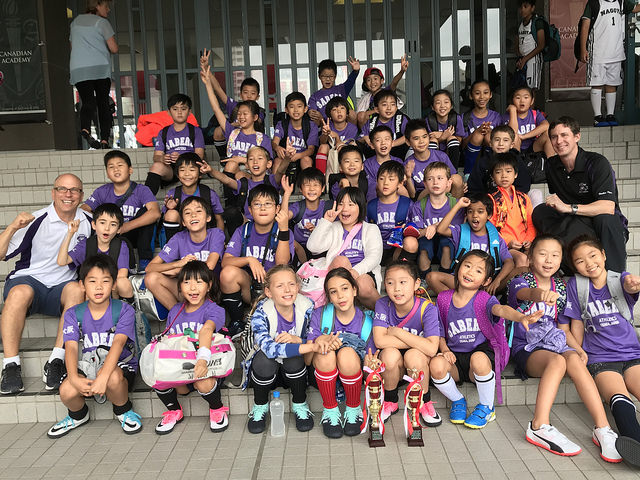
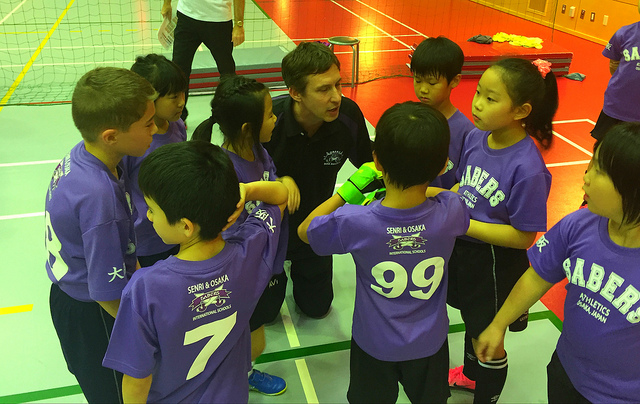
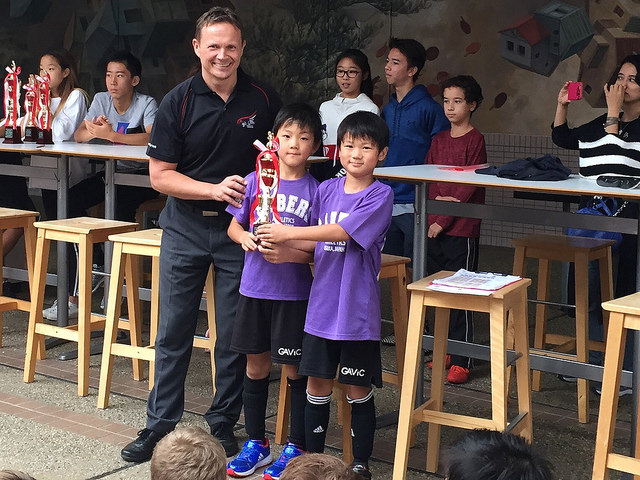
The elementary students have been so enthusiastic about our soccer program. Yesterday 37 students participated in the Falcon Cup on Rokko Island. All of the teams won at least one game and one team in the senior division finished third out of 24 teams and another in the junior division won the championship.
The goals of the after-school sports program for grades 3-5 are as follows:

I think we made strides in accomplishing all four goals so far this season. The games were moved inside due to the rain, but that did not deter from the fun. A special thanks to Canadian Academy athletic director Sim Cook for his organization and the school for hosting the event. There were over 30 futsal teams from 6 different schools, so it was a crazy day of kids running all over the place. I was especially proud of our students and it is good to see 12 girls playing on the teams. It is a goal of mine to increase the number of female athletes at our middle school and high school level and one way of doing that is to start them enjoying team sports in elementary school and hope it carries over to their later school years.

I also always say what is good for kids is good for adults and I think the coaches and parents enjoyed the day as much as the students. Gooooo Sabers!!!!!!

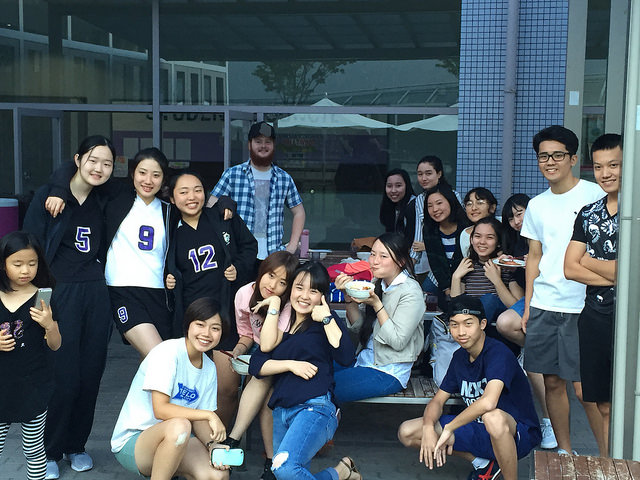
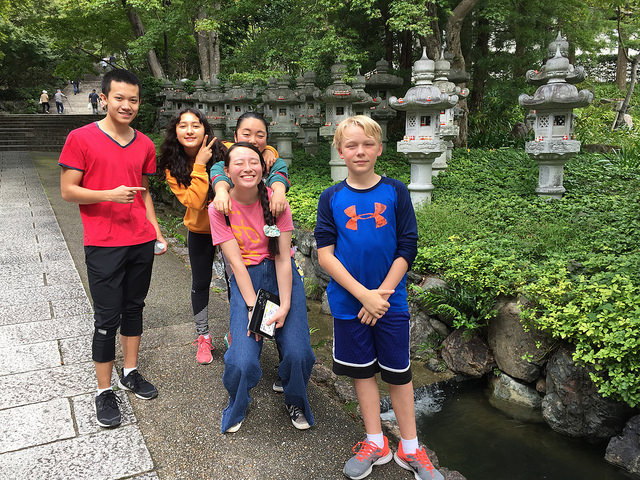
It is a special responsibility to run an international boarding program. We try to make the students feel at home and so from time to time, we hold events to give them a family experience. Last weekend we held a BBQ in the courtyard. Mr. Mecklem and Mr. Lewis were the master grillers, preparing perfectly done shrimp, beef and vegetables. Our dormitories have students from both schools, so we provide students with many opportunities to intermingle.

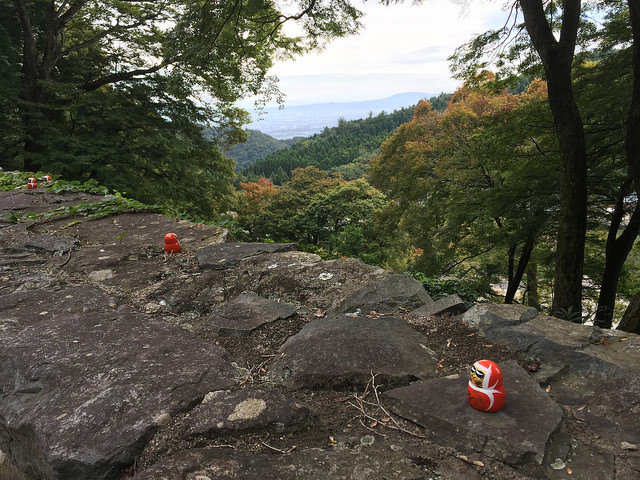
On Sunday we led them on a hike up through the Minoh Quasi National Park to the Katsuo temple. It is quite a beautiful setting and lots of interesting things to see and do. The temple is known for its “winner’s luck” and pilgrims come when they are faced with challenges in their lives. A daruma doll is placed somewhere on the grounds when an obstacle is overcome or a goal achieved.

Please contact the school if you are interested in learning more about our boarding program.

Congratulations to OIS seniors Nicole Yoo and Mark Yamamoto for being named National Merit Scholarship semifinalists. Demonstrating their dedication to their studies, they are pictured above on a very rainy morning in homeroom, hustling to school despite the inclement conditions. Mark and Nicole completed the PSAT last October and received their certificates last week. Congratulations!
The National Merit Scholarship Program recognizes students for outstanding academic achievement on the Preliminary SAT/National Merit Scholarship Qualifying Test (PSAT/NMSQT®). The top 0.5 % of the 1.5 million students from over 22,000 high schools are named semi-finalists. The program is only open to US citizens and the National Merit Scholarshipo Corporation is a privately funded, not-for-profit organization based in Evanston, Illinois, USA.
The PSAT assesses critical reading ability, mathematics problem-solving ability and writing ability, rather than existing knowledge. At the conclusion of the competition, a select group of finalists is chosen to receive university scholarships totaling over $35 million US dollars.
OIS administers the PSAT every October and students in grades 10 and 11 are eligible to sit the exam. For more information, please contact our learning support coordinator for more information.

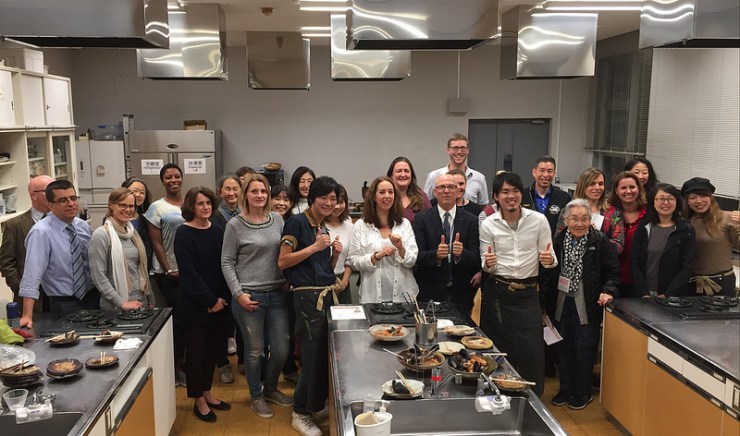
Last month Kwansei Gakuin Foundation Chancellor, Reverend Musubi Tabuchi hosted the new OIS faculty. The teachers toured the beautiful campus in Uegahara, a neighborhood that is part of the Nishinomiya suburb. Nishinomiya is between Osaka and Kobe and is famous as the home of Koshien Stadium and the professional baseball team, the Hanshin Tigers. Uegahara is 19 kilometers away from OIS.
Besides the tour, the teachers were treated to a sumptuous meal with a specifically crafted menu for the occasion. Chancellor Tabuchi explained the 128-year history of Kwansei Gakuin, which was founded by Methodist missionaries. The foundation still has a Christian ethos and is looking forward to a bright future with over 24,000 students, from doctoral students to pre-kindergarten students. The American architect designed the campus in a Spanish missionary style, and with the palm trees, it looks like California.
Mascots are popular in Japan and no tour would be complete without a visit with Honda, the mascot of the KG library. 本 hon is “book” in the Japanese language. Japan has the philosophy that mascots give institutions a human touch and encourages patrons to use their services. Honda sure makes me feel better about researching!

It was a delightful evening and a nice way to welcome the new faculty to the KG foundation. In the words of Reverend Tabuchi, “We are Kwansei!”

I recently read the 2017 International Baccalaureate (IB) yearbook and some statistics really jumped out at me. Heading into its 50th anniversary year in 2018, the IB is growing 11% a year. As of last September, there were 4,541 schools in 152 countries offering at least one of the four IB curricular programs. The IB infrastructure is challenged with this ever-increasing number of schools. I think the growth of the IB reflects the growth of the global economy and more parents want to give their children the skills and attitudes that aid their entry to this new workplace. More schools see the IB as a way to improve student learning and bring a higher level of rigor to their school.
In looking at the range of the over 4,500 schools world-wide, almost half of the schools are state (government) schools from the Americas region (47%), and surprisingly to me, there are more government schools (56%) than private schools (44%). The region with the most schools is Americas with 61% of the schools. The Osaka International School of Kwansei Gakuin is in the Asia-Pacific region which has 16% of the IB schools.
The IB offers four curricular programs, the Primary Years (elementary), Middle Years (middle/high school), Diploma (grades 11-12) and Career (grades 11-12). The most popular is the Diploma Programme, with 52% of the 5,889 programmes authorized by the IB.
OIS was the first school in the Japan/Taiwan/Korea region to offer the three main programmes (PYP/MYP/DP). We remain fully committed to the IB and feel it is the best curriculum out there for our students. We are looking forward to the 50th-anniversary celebrations of the IB.

The word for “he”, “she” and “it” in Chinese Mandarin is “ta”. The characters or kanji are different characters, but the pronunciation is the same. Chinese use more words to give context to the listener to help them understand. I learned this while sitting in the Mandarin class today after school. Ms. Irene Pan, a former OIS parent, and native of Taiwan teaches Chinese Mandarin on Mondays and Tuesdays after school. The classes are available to all OIS students.
There is a growing interest from our students and parents in learning Chinese. Some have Chinese heritage, but mostly I think, parents feel that it is becoming more important to speak the language due to the growing world influence of China. Being in East Asia, I really see the growth of China in the global economy and there are more Chinese working in or visiting Japan. Expatriate families are looking to help their children improve their career prospects by giving them an important world language. I don’t see it replacing English anytime soon, but before this century is out, Chinese may be just as common as English.
OIS students also have access to the Senri International School Mandarin teacher, Mrs. Kari Nakajima. She is also Taiwanese and teaches classes during the school day and after school. OIS high school with unscheduled periods during the day can take classes with SIS students if it fits their schedule. One OIS student is taking a class with her after school for high school credit.
As an IB World School, we support mother tongue and second and third language development. We support languages in a tiered system. For example, students with one or both Chinese parents who want to maintain their mother tongue would get first priority for support. Tier 2 are students who either lived in China and want to maintain the language or have an ethnic background. Tier 3 students have an interest in Chinese. Depending on the tier, classes may be free of charge, during the day and for a graduation credit, or after school with families paying a fee to the instructor.
We are trying to build our mother tongue program to support more languages in our community. Please see the appropriate principal if you are interested in enrolling your child in a Mandarin Chinese class.