The SOIS Health Centre: Meet School Nurse Natsuko Inoue

Ms. Inoue cares for all of our students, big and small.

I would like to welcome back our school nurse, Natsuko Inoue to the SOIS Health Centre. Natsuko recently returned to work after a year-long maternity leave. The school nurse is in charge of assessing the health needs of our community. The nurse does a variety of jobs, from giving medical care to students bumps and bruises, to teaching the faculty the use of an epi-pen, a device to use in case of a severe allergic reaction. The health centre is a great resource for parents, teachers and students, especially those new to Japan, for those seeking medical attention in the community.

Natsko is from Osaka and is a 2001 graduate of the Senri International School. She graduated from the Kobe Nursing College and is a certified midwife and she has licenses to be a public nurse and school nurse. Before working here in 2008, she worked as an operations nurse at a large hospital downtown. Ms. Inoue feels being the school nurse is special because she is taking care of students from both schools, Japanese and non-Japanese speakers, and they range in age from 4 to 18. She also enjoys helping faculty as well.

Parents are encouraged to visit the health center and/or send her questions regarding health. She will be happy to help.

OIS Parent Bulletin: April 23, 2015

Dear OIS Parents,

As always, I want to keep you up to date with events taking place at school. I have been quite busy with the elementary school principal / PYP coordinator search. We had two of the top candidates visiting last week. I will update you on all the new hires when they are all completed. The students also yesterday, enjoyed working in the gardens in honor of Earth Day.

There are many events taking place in the next week and a half.

Spring Recital: If you are in the mood for some beautiful music, the theatre today at 4:00 PM Thursday April 23, is the place to be. Students will be performing solo and duet pieces. Most of the students are in high school, but there are several middle school and elementary students performing as well. There will be piano, violin, cello and voice performance.

OIS Parent Open Visitation Day: Next Wednesday April 29th is a national holiday (Day of Showa) and many of our parents will not be working. We would like to take advantage of this and invite you to come and spend some time with their children at school.

The day will look as follows:

There are several workshops and discussions taking place. Humanities teacher Marcella Cooper will be giving MYP Personal Project Information Sessions at 10:30 AM, 11:30 AM, and 12:30 PM in her classroom, room #330. Grade 9 parents and other interested parents can come and learn more about the culminating activity of the Middle Years Programme.

Melissa Lamug, the counselor and I will be leading a discussion about fathers’ role in education at 1:45 – 2:30 PM in the third floor conference room. Information will be presented and fathers will be discussing their challenges in finding a balance between work and family time. Mothers are invited to attend! We are also looking for fathers who want to participate in the discussion. If you are interested, please send me or Melissa an email.

Kurt Mecklem will be giving an overview of the Middle Years Programme curriculum. If you want to learn more about assessment, objectives, etc. of the MYP, please attend his session at 2:45 – 3:30 PM in the third floor conference room.

Please RSVP the administrative assistant Chiaki Aotani (caotani@senri.ed.jp) with your attendance so we can arrange for refreshments at the presentations.

Classrooms will be open all day for parents to sit in on in the middle school and high school.

The elementary teachers will be hosting parents in the homerooms at various times during the day. They will be contacting you with details today.

Earthquake Safety: We will be having an earthquake drill sometime next week. The safety of students is important and we want to practice what to do in case of an emergency. We are improving the English documentation for our Crisis Response Manual and this is part of the process.

Projects Abroad: For those families looking for a summer experience for your 16-19 year old, you may want to check out projectsabroad.org. They also have a Japanese website here. I have never used them, but they do have some pretty good reviews. Melissa Lamug in the counselor’s office has lots of flyers and information about various camps, summer schools, etc.

Japan Council of International Schools Heads of Schools Meeting – April 10, 2015

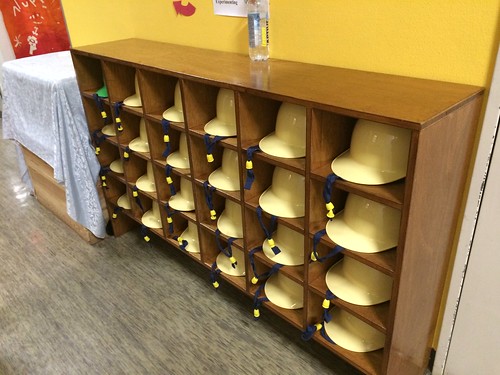
Schools in the Kanto region by law need to have hard hats for students in case of earthquake.

The JCIS spring meeting for the 2014-2015 school year is being hosted by the Seisen International School. Seisen is a Catholic girls’ school in a suburb of Tokyo. The Handmaids of the Sacred Heart is the order of nuns that manages the school. I would like to thank Sister Margaret Scott, the head of SIS and the rest of the team for their hospitality.

Below are my takeaways from the meeting:

Child Protection – All international schools in Japan are struggling with trying to get police clearances for their employees. In Japan this is confidential information and authorities will not search and release records. Due to several publicized incidents recently of international school schools dealing with child abuse by faculty and staff,  accreditation agencies are requiring schools to do background checks on employees. International school teachers in Japan are also worried about getting a background check which many schools are requiring. JCIS will document our schools’ effort in seeking these checks which may help with accreditation visits. Two schools had some success using a firm and that will be shared with the heads.

Organization Business: Our mission, membership criteria and professional development funding were discussed. Currently there are 30 schools in JCIS. JCIS funds many PD opportunities. This is a good for international schools as most have small enrollments and with travel, PD costs can be high.

In the announcement / quick questions session, heads of schools brought concerns to the group. I asked about waiting lists/applicant pools, taxable educational benefits for expatriate employees and the possibility of combining our higher education data of the JCIS schools to better see trends with international school students in Japan. Most of my notes from this portion of the meeting are private.

I also learned about an excellent open source course through Ed X called Visualizing Japan: Three Online Mini Courses by Harvard, MIT, and U of Tokyo. The courses are now over but the archive can be accessed and most of the material can be read.

View of the sports grounds of Seisen IS – land is at a premium in Tokyo

I am looking forward to the next JCIS meeting of the heads of schools which will take place in September 2015 in Kobe at the Marist Brothers International School.

OIS Parent Bulletin: April 3, 2015

Dear OIS parents,

I would like to welcome everyone back to school for the spring trimester and hope you had a relaxing time with family. The faculty started working yesterday and we are all looking forward to an exciting finish to the school year. This is an emotional time for the parents of our grade 12 students and encourage them to enjoy the experience and try to spend some extra time with their graduating senior son or daughter. The next issue of Educator comes out next Friday April 10th. I wanted to keep you up to date with school events before then. Also note I will be attending the Japan Council of International Schools (JCIS) meeting of heads of schools April 9 – 11 hosted by the Seisen International School in Tokyo.

Upcoming Events

  • Tuesday April 7 – The elementary school students will be UN World Health Day with a “wacky hair/hat” day. The idea is to raise awareness for cancer treatment. Linda Ragsdale, activist and leader of the Peace Dragon Project visited us back in October and she is currently battling cancer.
  • Wednesday April 8 – OIS Parent Teacher Meeting 8:45 AM Third Floor Conference Room (a picture will be taken of the new members)
  • Thursday April 9 – Kindergarten Easter Egg Hunt
  • Friday April 10 – IB Diploma Programme Visual Arts Exhibition Opening – more details forthcoming
  • Wednesday April 29 – We are planning to invite OIS parents to come to school on Wednesday April 29 to do some activities with their children. It is a national holiday and some of you may not be working and it may be possible for you to come in. The team has been brainstorming ideas and will send concrete plans later this month. For now, just be aware that we are thinking of doing some event on that day.

New Faculty: I would like to introduce Teruko Clark to the OIS community. Mrs. Clark will be teaching Japanese language this term in the PYP and MYP. She is covering a maternity leave for Kazue Sudo, who will return in April of 2015. Teruko has a long association with OIS. Her daughter, Sophia, graduated from OIS in 2010 and recently from the University of Oregon in the USA. Mrs. Clark also has been a substitute teacher at OIS since 2008. She is a graduate of Osaka Seikei College and has certification in kindergarten and elementary teaching. She is an accomplished pianist, and has taught private music lessons to children and adults for years. Teruko is looking forward to the assignment, as she loves children and enjoys seeing them grow.  She appreciates the different cultures at OIS. We are happy to have Mrs. Clark as part of the faculty.

Professional Development: Over the spring break holiday, early childhood teachers Dawn Inada and Wakaba Mori attended the EARCOS (East Asian Regional Council of Schools) teachers conference in Malaysia. They came back with many ideas and were inspired by the speeches and presentations they attended. It is also a chance to share best practices with teachers in other international schools. The school appreciates our faculty giving up their time during their breaks to continue to improve their teaching. Both teachers will also be traveling to a workshop and job-alike next week at the Nagoya International School.

New Families to OIS: We welcome six new students to OIS for the spring term. Families are coming from the USA, China, Dubai, Singapore and Japan. More information will be given in next week’s Educator.

SOIS Featured in IB Global News: OIS is the featured school in the current e-newsletter of the International Baccalaureate. The issue of IB Global News can be accessed here. The IB Global News is a web-based newsletter that is sent to schools and interested parties around the world, five times per year.

Campus Facilities Improvements: The KG facilities department did much work over the spring break. They completed resurfacing the elementary school playground and installed a climbing ramp and play apparatus. LED lighting systems were installed in most of the classrooms on the second and third floors. A video screen was also installed in the genkan for announcements and school photos and videos.

Parent Resource: I occasionally like to suggest media that OIS parents may be interested in. New York Times columnist Frank Bruni wrote the essay “How to Survive the College Admissions Madness” based on his new book, Where You Go, Is Not What You Will Be. He regularly writes about higher education for the New York Times.


Career-related Programme (CP)

This is another of the posts from the IB Asia Pacific Regional Conference in Macau, March 19-21.

CP Career-related programme (current model teaching until May 2016) 

1. career related studies / DP courses (complete 2 from any group)

2. Community and Service / ATL / Language Development / Reflective Project

  • 100 authorized schools for the CP in 2015 and will reach 120 schools
  • 40 schools in 2012 – started higher than any other IB program
  • workplace is getting closer to the classroom
  • 15 countries (China, Thailand, Germany)
  • 1000th CP candidate
  • business and marketing 53% / engineering 36% / medical 35% / IT-Programming 31% / VA-PA photography 28% – health and social 13% – food/culinary 11% – architecture-building-construction 10% – education 10% – sports 10% media 10%
  • subject group 3 is the most common choice – group 5 2nd – group 4 3rd – math studies is the most common DP exam choice;
  • average number of CP courses is now 2.6
  • language development is in the core, but it is not a DP course

It is a very cheap option, $1,500

Benefits 

  • raised aspirations – university and employment is not for them?
  • increased # in university
  • otherwise disengaged, now focused and motivated with the CP
  • employers and local community links increased through the CP
  • 70% of high school students pursuing career-technical education (CTE) with the CP went on to 2 or 4 year colleges after high school

In the future, new PD opportunities will be developed by the IB, it can be a stand alone programme so branch out into vocational schools, and they will add a “personal and professional skills” course.

IB Programme impact research – current and future studies

This workshop is run by Brad Shrimpton, the IB Global Research Manager of the Asia Pacific region. He is a former university professor from Australia and is based in Singapore. He commissions 40-50 research studies per year in Asia Pacific. By commissioning, that means that Brad outlines studies and collects offers from universities in the UK, Australia, USA, Japan and Spain to conduct the research. They are totally independent from the IB. The IB publishes research findings both “good” and “bad”. The research is published on the IB website here.

The IB Global Research department is very large and there are three main areas.

program development research (Hague)- literature reviews and case studies to find best practices in the schools

quality assurance (Washington) – evaluating professional development, authorization/site visits

program impact research (Washington/Singapore)- the value and impact of an IB education

IB makes big claims in academic achievement at university and success post university across the course of their lives.learner profile, university outcomes, success post university and across the life course – where is the evidence? The research commissioned by the IB is the evidence. This evidence is good for parents, governments and school that want to know if they should work with the IB. The research contributes to scholarly knowledge and improves the IB.

Outcomes from two recent IB Asia Pacific studies

PYP outcomes in Australian state schools 

In a study of 13 PYP schools in Australia, Annette Gough from the Royal Melbourne Institute of Technology found that on the NAPLAN, a standardized assessment in Victoria, student achievement in reading and numeracy in grades 3 and 5 from 2008 – 2012 was higher than in like schools and all Australian schools. The study also found much more benefit from the PYP than just the NAPLAN results, and anecdotal evidence demonstrated students were more independent learners, showed international-mindedness, etc. For schools, improved outcomes included encouraging students to take control of their learning, a shared languagem deeper understanding of concepts and a better school climate,  A negative effect on the school were the high fees and PD costs. Some teacher comments included, 

  • “It has given me a whole new love of teaching.”
  • “I am more engaged and therefore my students are more engaged.” 

They are next doing a study looking looking at the MYP in 10 Malaysia state schools.

Learner Profile in the DP  A researcher at the University of Melbourne found in 9 schools (3 each in India, Hong Kong, Australia) that the teacher and student awareness and understanding of the Learner Profile attributes in the DP were quite low.

Future Studies – 2015…

  • school assessments of international mindedness
  • ISA results in the Asia Pacific – grades 3-10 PYP/MYP
  • Evaluation of MYP Next Chapter
  • Student perceptions of the impact of CAS
  • impact of IB PD training

Making Strategic Use of Higher Education Data in International Schools

A nice graphic from the English Schools Foundation on fields of study for their graduates.

Students at OIS-KG are accepted at many outstanding universities around the world. We are proud of them, and most importantly, they get to pursue their dreams. I am attending this workshop at the IB Asia Pacific Region Conference to better analyze where our students go to university, better promote it in and out of our community, and ultimately, to improve the higher education and career opportunities for our students.

This workshop is being put on administrators from the English Schools Foundation, which operates 15 schools in Hong Kong. They were established by the British Hong Kong government in 1967. 90% of the over 1,000 ESF students graduating from their schools, exit through the DP diploma.

Good Idea – They showed a creative example of how a school can demonstrate where their graduates study in higher education. A map of the world with pop-out names of universities and/or students is in my opinion, much better than a list.

They have accumulated a database of 5000 graduates from their schools over the years and they asked these questions.

  • What do they do after they graduate?
  • Which countries / universities do they go to study?
  • What are they studying at university?
  • How accurate/generous are students’ university predicted grades?
  • How “successful” are students in being accepted into university?
  • Are we ambitious enough with our applications? (first choice)
  • Do students with unconditional offers from US offers “drop-off” with their IB exams?

They suggested for schools to do the following:

1. Centrally store applications, offers, and destination data

2. Create a database that counselor and students can share.

3. Analyse and understand the data

4. Decide on priorities and development.

ESF Statistics

  • 88% higher education 10% gap year (doubled since 2010) 1% military service (Israel, S.Korea,Singapore)
  • gap year – Why? (68% by choice with deferred place – 32% did not get offers or re-take IB exams)
  • more students are staying in Hong Kong in recent years; trend – they are looking for more diverse places in Asia because Hong Kong is full, HK is cheap
  • Because the USA is so expensive, the number of students is steady and the stronger DP students go study there.
  • trend – medicine in HK

Predicted grades

  • Most schools use the grades to parents pessimistic and grades to universities optimistic
  • UCLA admission officer in attendance said he found 2.8 +/- from predicted DP grades to actual and they keep a list of over-predicted schools that are too high and take that into account.
  • University of Melbourne got back to HSF – recently some DP schools are considered better than others
  • U British Columbia – they did a study of first-year exam performance for Asian students 34-35 same as an US student gets a 29 – they are offering lower grades to US students;
  • how do we get our students more informed about the admissions process? they send counselors with “readers”
  • HSF students 5.67 average predicted grade – 5.54 actual
  • 1/2 of predicted grades were spot on – half are +/-1; easy to explain -4 or -3, crisis, but difficult to look at +3?
  • HSF wants to push the overall graph over to overselling our students; examine high performers are being undersold, how to identify them

How do we measure success?

  • % of getting a place at university
  • scholarships
  • accepted at first/second choice of universities
  • % accepted at “top-ranked” universities (goal is the fit)  – HSF 10%  – which rankings do you use?
  • application success rates (top-ranked US universities – which ones are we highly successful vs. lower successful)

Other notes:

  • publish offers, deceiving when 1 student gets three or four offers?
  • hot discussion on limiting the number of applications, some are 6 firm, some are not
  • We are the guardians of our reputation! The policies and practices will be based on evidence. Are we spending too much time weighing the pig instead of fattening it.
  • Smaller schools keep yearly data – share with other schools – collect evidence!

IB School Enhancement Services – Building Quality Curriculum

Erin explains the Building Quality Curriculum service.

This post is a series of my learning from the International Baccalaureate Asia Pacific Region Conference in Macau in March of 2015.

IB offers a large suite of services for IB schools. They are started a “school enhancement” service department based on feedback from schools in 2012. This is to help schools post-authorization and for schools approaching the 5-year review or evaluation. This particular workshop is given by Erin Albright, Head of Post-Authorization Services, IB Global School Services and explains the Building Quality Curriculum service, which is one of the four services under the enhancement department. The goal of the service is to give more timely feedback to teachers to improve the planning of curriculum. A school using Building Quality Curriculum would submit unit plans and self assessment to the IB. The IB provides written feedback and the school then has a month-long period of conversations between the PYP program of inquiry, units of inquiry and MYP unit plans.

The IB school selects 6 PYP and 2 MYP (16 unit planners) subject units, completes a self-assessment and submits the units plus UOI. They piloted it with 26 schools in 2014. Participants thought it was helpful for schools approaching evaluation and it was a great starting point for coordinators working with faculty. 84% of the schools did not use the month-long period of questions/conversations.

The 2015 pilot is inviting schools to participate and the goal is to find 60 schools. The application deadline is July 24, 2015, documents are submitted in September, and feedback comes back mid-November. (GSS@ibo.org) – Global School Services email. The fee is $385 for the six PYP planners and $880 for the MYP.

Plans for 2016 – It will be offered as an optional service for PYP. Mandatory at program evaluation for schools not participating in eAssessment. This is an optional service for other schools. This BQC will replace the monitoring of assessment because IB thought that the it was too late to improve learning to be looking at the assessments and so they hope that the earlier feedback on the planning side of the learning will be more beneficial. As a counterpoint, the assessment focuses on students and the unit planners focus on the teachers.

Dr. Michael Anderson (Literacy, Mathematics, and Creativity)

Michael Anderson is an education professor at the University of Sydney. His research interests are creativity, technology, the arts, especially theatre and film. He referred to this website to supplement his speech. He is the second keynote speaker at the IB Asia Pacific Annual Conference 2015 here in Macau.

Creativity should be the center of schooling and sit besides literacy and numeracy. It is urgent in the rapidly changing global economy for our students to be creative. Why?

#1. How suseptible are jobs to computerization? Of the 702 occupations studied, half are at risk. What jobs will be available for our students?

#2 Students that engage in the arts as active participants enjoy school more, have higher self esteem, are happier, and have higher achievement in schools. Dr. Anderson’s research is here.

#3 Challenges that will face the next generations of humanity – world events like climate change, food/fresh water security, clash of cultures

There is a misunderstanding of what is creativity. It is trial and error, improvisation, playful exchange of ideas among students and teachers. Dr. Anderson used the metaphor of a waterfall cascade to teach creativity.

The first pool in the cascade is noticing. Dr. Anderson used this Diane Arbus – image to get us to look critically at a photograph. The second is asking why and then asking really why?

Dr. Anderson pointed to the life of Elon Musk, a modern day Leonardo Da Vinci. He invented pay pal, tesla electric car, etc. Only 15 of the 1000 people in the room knew who he was. He is the paragon of asking why. “Why is it hard to pay for things on the internet?”

Playing with possibilities – improvisation, trial and error,

Evaluating Responses – not all feedback is good feedback; usefulness of the response; seek feedback from someone who understands the project; discerning responses to the creative process and project

Things you can do at your school

1. Do a creativity audit – Is creativity happening in the classrooms?

2. Work with all stakeholders to put creativity front and center –

3. Use the research on creativity

Dr. Anderson was featured in the December 2014 issue of IB Global News.

High Quality Learning in Fine Arts that lead to students having critical, creative skills —>

  • Teachers engaged students in both mind and body. (compose, sculpt, film, play)
  • Resilience perseverance – failure happens all the time and is accepted
  • critical reflection
  • great discipline (rigorous, controlled, exacting form in the specific arts)

IB Asia Pacific Annual Conference 2015 Keynote Speech – Julia Gillard

I am at the International Baccalaureate Asia Pacific Annual Conference 2015 in Macau. The keynote speaker is former Australian Prime Minister, Julia Gillard (2010-2013), a labor party politician. Before becoming prime minister, one of her posts was Minister of Education, Employment and Workplace Relations and Social Inclusion. She is now a non-resident senior fellow at the Brookings Institution in Washington, working with the Center for Universal Education (CUE) She is also Chair of the Board of the Global Partnership for Education. The CUE is a policy center and think tank that works on improving access to quality education for all in developing nations. Her talk today is answering the question, “How can the world ensure a quality education for all, in both developing and developed nations?” She will also discuss how IB assessment practices can drive global student achievement.

MACHINES The digitization and rise of robots or artificial intelligence is a major revolution in our society, the second machine age. Machines are increasingly able to do routine, repetitive knowledge work, like filling out taxes, payroll accountants, call centers, etc. Non-routine, non-manual work is the safest of all from machines. She cited the book, “The Second Machine Age: Work, Progress and Prosperity in a Time of Brilliant Technologies“, by Erik Brynjolfsson and Andrew McAfee. What does this mean for our children?

  • Creativity
  • Analyze for Meaning big data sets (working out what it means!)
  • Teamwork among people and machines (soft skills,

MONEY Asia, especially China’s unprecedented growth, is the biggest opportunity for our students. In a few years time, our region will be the home of the biggest middle class in the world, more than the rest of the world combined. For example, Apple was the first company to hit a market capitalization to hit $700 billion, and it did so through selling products to Asian consumers. The needs of this middle class include quality education, hence the rise of private, international schools. The world will hunger for people that can forge links to Asia.

MEN She also mentioned her experience at some of the economic summits, where she was the only woman (example above).  The importance of education of equality for gender is imperative. She cited numerous studies that show students unconsciously favor male teachers over female teachers, which means cultural stereotypes run deep and women in leadership are viewed negatively. Machines, Money and Men are the prism that she looked at the future. Under 2% of developing country aid goes to education. So many of the world’s ills can be helped through education. We as international educators must push for more funding to go towards schools in developing nations. Privileged IB schools have the responsibility to work towards gender equality and better schools in the developing world.