
IB Association of Japan Meeting

26162176850_11bf3343de

Yesterday I attended the International Baccalaureate Association of Japan meeting at the K International School of Tokyo. The goal of the organization is to serve the international IB schools in Japan by being a forum to share ideas and advocate with the IB for our needs. We are also trying to support the Japan Ministry of Education (MEXT) goal of spreading the IB curriculum to 200 local schools in Japan by 2018.

Ayumi Hoshino the head of the IB initiative here in Japan reported that there are 36 IB schools in Japan, 13 of which are article I. 12 of those are Diploma Programme (DP), 3 Middle Years Programme (MYP) and 1 Primary Years Programme (PYP). The head of the PYP school, the Sunnyside International School from the Gifu prefecture (near Nagoya) was in attendance. It is 2016 and two years into the project and 13 Article I (registered officially with MEXT) schools is way short of the MEXT goal. It was really unrealistic because the IB curriculum is such a mind shift from traditional nationally-based schooling in Japan. However, it is my opinion, that it is the perfect curriculum for Japan’s needs in this global economy. It prepares students to be leaders in the global economy. Japan needs to reach out to other cultures to continue its economic success and with aging demographics, the young people of today may be needing the “intercultural competence” that a well-run IB program can do.

There are lots of challenges in spreading the IB to Japan. Officials at MEXT are bureaucrats, not educators and there is some disconnect between them and schools. There is a lack of communication about IB initiatives like workshops and there are a lack of trained and experienced Japanese speaking educators to support Article I schools applying for IB authorization. There are a range of workshops in Tokyo in early August in Japanese. SOIS will be sending several faculty to them. The IB Asia Pacific region is also planning on hosting its big leadership conference in Yokohama for the first time next March.

I spoke to Ayumi privately to urge her to continue working with universities in Japan to recognize and recruit IB diploma graduates in both English and Japanese programs. Professors from Tamagawa and Tsukaba were there and they not only accept IB graduates, but they also offer IB certification for teachers. More schools are coming around to the IB here but it will take time. OIS has sent several students through the IB track to the prestigious Osaka University. It would be good to get the other large public universities doing the same. They are the “Ivy League” highly selective universities in Japan, which differs from the USA, where mostly private schools are the most selective.

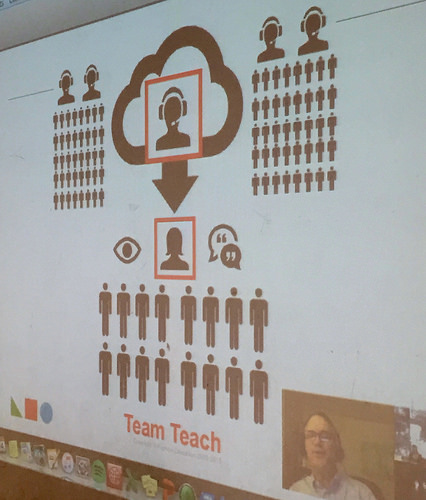
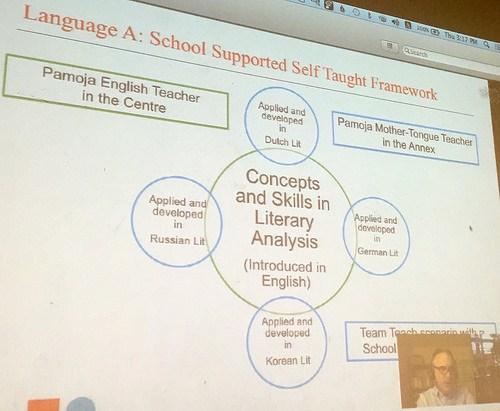
Finally, we had a long video conference with the leader of Pamoja Education, which is the only online provider for the IB. They offer many IB courses online and these help schools individualize student schedules and reduce expenses for covering language classes and others that do not have big enrollment. Pamela is rolling out the concept of “team teach” which means schools can have students take the regular Pamoja course, but with greater support of a “site-based coordinator” (SBC) at the school. The SBC would supplement the online course by working with the students on homework, conducting field trips, leading discussions, etc. The student benefits by being able to interact with more students from all over the world and have not one but two teachers. I think this blended learning model is the future of education and I would like to experiment with it at OIS. Pamoja announced new courses which include the self taught languages, English A Literature option, Theory of Knowledge and the three natural sciences (biology, chemistry and physics) which is very exciting! Above is a slide from the Pamoja presentation showing the Team Teach model. The slide below is the self taught language model. The online portion is in English which all the different language students take together and the blue circles are the individual languages which could be done online or with a tutor at the school.

25830173934_f7f9c010c7

SIS Math Teacher Publishes New Book

Congratulations to Senri International School mathematics teacher Hiroshi Baba on the publication of his book. “International Baccalaureate (IB) Mathematics” and is intended not only for teachers in Japanese public and private schools but for anyone interested in learning more about IB mathematics curriculum. The book will be instrumental for those IB candidate schools becoming authorized to offer the IB Diploma Programme. The Ministry of Education, Culture, Sports, Science & Technology (MEXT) has set a target of 200 high schools in Japan to offer the Diploma Programme. Baba sensei’s book will aid that effort for mathematics teachers looking for resources in the Japanese language. Japan is trying to globalize its curriculum to prepare students for working on an international level in our ever increasing interconnected economy and lifestyles.

There are differences between the IB Higher Level Mathematics course, the most rigorous IB mathematics offering and the mathematics level 3, the most rigorous Japan national curriculum mathematics offering. The IB higher level includes units on inverse trigonometric functions and vector products not found in the Japanese national curriculum. There are other topics that are covered in Japan that are not found in the IB. The book offers ideas for teaching these concepts and units not found in  the national curriculum.

OIS and SIS are making efforts to more closely align their timetables and classes to allow students from both schools to take IB Diploma Programme (DP) courses. The idea is to give our students more course offerings and more classmates to take the full DP. Eventually, many IB DP courses will be offered in both English and Japanese in several subject areas, including mathematics. Baba sensei has played an integral part in this initiative. He has been at SIS for 23 years and besides serving as the coordinator of the mathematics department, he is also founder and coach of the SOIS triathlon club and editor of Interculture, besides his teaching, homeroom and committee duties. SOIS commends Baba sensei on his new book and helping advance education in Japan to become more globally minded. He truly is living our mission statement of contributing to a global society. Banzai!


Thirty Million Words

A world-famous study by researchers Betty Hart and Todd Risley (1995) found that some children heard thirty million fewer words by their 4th birthdays than others. The children who heard more words were better prepared when they entered school. These same kids, when followed into third grade, had bigger vocabularies, were stronger readers, and got higher test scores. The bottom line: the kids who started out ahead, stayed ahead; the kids who started out behind, stayed behind. This disparity in learning is referred to as the achievement gap.

The excerpt above is from the website 30 Million Words, an initiative in early childhood education. The idea is that children of educated, richer parents, hear on average 45 million words from birth until age 4, while children of undereducated, poorer parents, hear on average 15 million words. This creates a gap in vocabulary and achievement in schools. The goal of the initiative is to help poor parents to get more language in their homes by supporting them in focusing on vocabulary. Hopefully this will lead to them speaking with their children more often.

The takeaway for me as leader of a school that does not have poor families, is that it is still important to for parents and teachers to speak with children, especially English language learners.  Less Youtube and gaming, and more conversation in the home goes a long way.


High Cost of Academic Journals

I listened to the story below with great interest. Academic journals are very expensive and most research studies cannot be read online without paying a high fee. This hit home with the school’s subscription to the Journal of Research in International Education. This is an excellent journal with research on K-12 international schools. There are three issues per year and the yearly cost is $US 352. That is over $100 per issue! I cancelled our subscription because of it is so expensive and I couldn’t justify the amount we were paying with how much we get from the journal articles. I might look into downloading individual articles, but those are $36 per article.

There has to be a better economic model. This not only applies to educational journals, but also medical journals. When people are diagnosed with an illness and want to see the latest research on that particular illness, they will have to pay a lot for access. It would make for a better world if academic journals lowered their fees and more people had access to this latest information.

The link to the NPR story is below.

http://www.npr.org/2016/02/20/467468361/expensive-journals-drive-academics-to-break-copyright-law