OIS Parent Bulletin – February 29, 2016
Thirty Million Words
A world-famous study by researchers Betty Hart and Todd Risley (1995) found that some children heard thirty million fewer words by their 4th birthdays than others. The children who heard more words were better prepared when they entered school. These same kids, when followed into third grade, had bigger vocabularies, were stronger readers, and got higher test scores. The bottom line: the kids who started out ahead, stayed ahead; the kids who started out behind, stayed behind. This disparity in learning is referred to as the achievement gap.
The excerpt above is from the website 30 Million Words, an initiative in early childhood education. The idea is that children of educated, richer parents, hear on average 45 million words from birth until age 4, while children of undereducated, poorer parents, hear on average 15 million words. This creates a gap in vocabulary and achievement in schools. The goal of the initiative is to help poor parents to get more language in their homes by supporting them in focusing on vocabulary. Hopefully this will lead to them speaking with their children more often.
The takeaway for me as leader of a school that does not have poor families, is that it is still important to for parents and teachers to speak with children, especially English language learners. Less Youtube and gaming, and more conversation in the home goes a long way.

High Cost of Academic Journals
I listened to the story below with great interest. Academic journals are very expensive and most research studies cannot be read online without paying a high fee. This hit home with the school’s subscription to the Journal of Research in International Education. This is an excellent journal with research on K-12 international schools. There are three issues per year and the yearly cost is $US 352. That is over $100 per issue! I cancelled our subscription because of it is so expensive and I couldn’t justify the amount we were paying with how much we get from the journal articles. I might look into downloading individual articles, but those are $36 per article.
There has to be a better economic model. This not only applies to educational journals, but also medical journals. When people are diagnosed with an illness and want to see the latest research on that particular illness, they will have to pay a lot for access. It would make for a better world if academic journals lowered their fees and more people had access to this latest information.
The link to the NPR story is below.
http://www.npr.org/2016/02/20/467468361/expensive-journals-drive-academics-to-break-copyright-law
High Achievement on PSAT

OIS students in grades 10 and 11 completed the PSAT (preliminary scholastic aptitude test) on October 14, 2015. This month the results will be mailed to the students but schools have access to the scores online. The PSAT is a preparatory test for the SAT, which is used by many universities in the United States and other countries for admission decisions. Both tests are written by College Board, a non-profit organization dedicated to “connecting students to college success and opportunity”.
The results of the 26 SOIS students taking the exam were remarkable. Six grade 10 students scored at or above the 90th percentile of all students taking the test. Over 3.5 million students are tested annually with the PSAT. Almost all the OIS students scored above grade level benchmarks. The average score of the OIS students is between the 70th and 80th percentiles of all test-takers.
The faculty and administration were especially interested in these PSAT scores because it was the new version of the PSAT. The SAT test is changing formats this spring and the October 2015 PSAT test, which prepares students for the SAT and gives them an indication on how they will perform, was the first administration of the new test format. The changes in the SAT are claimed by College Board to reflect more accurately, high school curriculum. They are taking heavily from the American “common core” standards. The common core are a set of clear college- and career-ready standards for kindergarten through 12th grade English language arts/literacy and mathematics. Many states in America are adopting the literacy and mathematics common core standards. The new SAT is supposed to reflect what the students are learning in school and is more similar to the ACT, the other big admissions test used by North American universities.
OIS counselor Melissa Lamug will meet individually with all the students to go over their results. The PSAT results come with booklets that explain the answers. OIS testing coordinator, John Van Plantinga has many resources for students who want to improve their scores or prepare for the tests.
We are a College Board testing center and we administer the SAT several times a year. Our SAT sessions on May 7 and June 4 will be the new version of the SAT that debuts internationally in next month.
Congratulations to our students on their fine performance on the PSAT!
Further reading:
Everything You Need to Know About the New SAT New York Times October 28, 2015 (link)
Common Core website (http://www.corestandards.org/)
OIS Alumna Recording Artist Jyongri
The other day while driving over to the Kwansei Gakuin campus, the leadership team heard a song by OIS alumna, Jyongri come on the radio. She graduated in 2005 and went on to become a pop star in Japan. Above is one of her many singles, “Unchanging Love” that reached the upper echelons of the Japan music pop charts. She has been a recording artist and songwriter, living in Tokyo since her debut single, “Possession – My All For You” reached #16 in 2006. Her songs have also been featured on many television programs ending themes. She also studied at the Berklee College of Music and Waseda University in Tokyo.
Our school has one of the best music programs in the world for international schools and Jyongri is one of the many examples of the talented musicians that have studied at SOIS. She was a highlight of the 20th anniversary celebration of the school five years ago, as part of the community performances. Whether it be popular music or classical or even traditional, the talented students and graduates of SOIS continue to make their mark in the world of music.
We wish her continued success in her career and are looking forward to hearing her next release.
Open Doors Report 2015

(graphic courtesy of Study Travel Magazine)
I read with interest the latest statistics from the Open Doors report. The report is funded by the US Department of State and is done by the non-profit organization, the Institute of International Education. The report shows enrollment statistics of international students studying the USA and American students studying abroad. Approximately half of OIS graduates matriculate in the USA.
More international students are going to the USA to study. This year had the highest growth in 35 years, with almost 1 million students enrolled in American universities. The USA hosts more internationally mobile students than any other country, more than double the second most host country, the United Kingdom. Just under 1/3 of the students are Chinese and they are fueling (along with India) most of the growth. This reflects China’s growing economy. About 300,000 Americans go abroad for study, with the UK being the most popular destination.
Approximately 20,000 Japanese citizens study in the USA. Japan from 1994 – 1998 lead the world in sending students, peaking in 1997 with 47,000 students. I am not sure why less Japanese are going to the USA. Reasons stated in the report are the effects of a rapidly aging population, the global economy and recruiting practices of Japanese companies. Japan ranks #8 in number of students studying in the USA.
SOIS students certainly have more options than I had growing up in rural Michigan. That is true with most international schools. I also see a growing trend of American universities having international campuses. For example, Temple University (Philadelphia, PA) has a Tokyo campus and two OIS students are matriculating at New York University’s Abu Dhabi campus. University education will continue to more international.
SOIS French Teacher Releases New Book

Congratulations to SOIS French language teacher, Pierre Turlur on the publication of his book of haiku poetry, entitled Montagnes Flottantes “Floating Mountains”. A scout from one of the largest French publishers, L’Harmattan, found Pierre’s blog, Blue Mountain and fell in love with his poetry. Mr. Turlur writes a “free form” style of haiku that is inspired by moments that occur every day in his life. Although he is well read in the classic haiku poets like Bassho and Issa, his haiku do not conform to the traditional fixed rules and rhythms and he is following the footsteps of Santoka and Shiki. His poetry helps him connect to the vivid, interesting things that others may notice in passing, but do not fully appreciate. For example, his haiku below came from a snowstorm that occurred here at school and watching the students cross the courtyard:
She goes kissing
everybody’s lips
whirling snow.
Pierre, a former professor of literature in French universities, not only teaches at SOIS, but also in the Lycee Français of Kyoto and the evenings at the Institut Francais in central Osaka. On the trains he spends much time traveling between school and his home in Nishinomiya. He uses this time often to observe his surroundings and while many others are escaping reality with the phones, Pierre is writing haiku.
standing at the crossing
cars, fumes and noise
the very flower
He has always had a connection with Japan, studying Zen Buddhist practices from a young age. Pierre is a bit of a renaissance man, not only teaching, but he is also a musician, author and certified Buddhist priest. His wide variety of interests makes his classes interesting for our students.
Mr. Turlur teachers several OIS students and has prepared them successfully for passing the DELF. As an IB World School, we promote the maintenance of mother tongue language and learning other languages. We encourage our students to study French and other languages.
We wish Pierre brisk sales and more books to be published! Although the poems are in French, if you are interested in purchasing the book you can contact the author or order a copy directly from the L’Harmattan website (link here).
Kwansei Gakuin Council Meeting #246
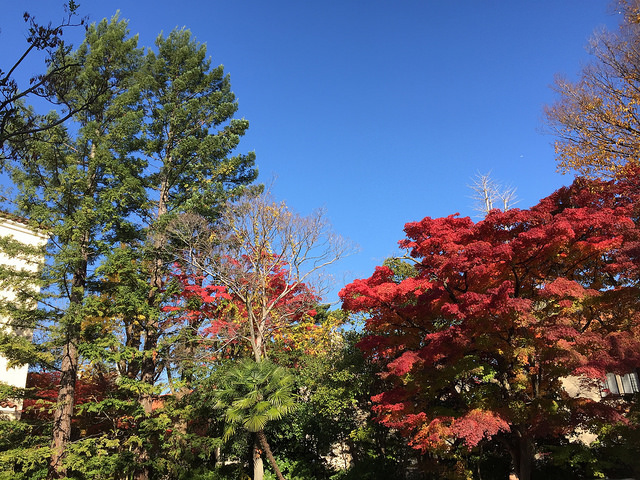
(photo – The glorious late autumn colors at the KG University campus)
This morning members of the leadership team are attending the Kwansei Gakuin (KG) Council meeting at the main campus in Uegahara. In Japan, organizations keep track of the total number of meetings of the group, so this is the 246th meeting in the history of the council.
The chair of the KG BoT, Akira Miyahara, the former CEO of Xerox and Fuji, in his opening speech referred to the ASPEN Institute in Washington DC. Below is a description of their work.
The Aspen Institute is an educational and policy studies organization based in Washington, DC. Its mission is to foster leadership based on enduring values and to provide a nonpartisan venue for dealing with critical issues. The Institute has campuses in Aspen, Colorado, and on the Wye River on Maryland’s Eastern Shore. It also maintains offices in New York City and has an international network of partners.
There is also a branch of the Aspen Institute in Japan. I see they hold events for high school students, it might be worth looking into. They seem to focus on week-long workshops, studying classic works and having deep conversations about leadership and human values. I think it would be great to attend one. They also have podcasts that might be interesting to listen to.
Every council meeting the various KG schools give reports on current events at the school. The first up was the Seiwa Junior College, which prepares women for careers as early childhood and elementary teachers, day care workers, etc. The second school was the KG Junior High School (grades 7-9) in our system. To start their school year, they have a mud rugby game. They spray water to make mud and the students seemed to be enjoying themselves. The head of the school played videos of the summer camp to an uninhabited island in the Okayama prefecture and the grade 9 trip to Nagasaki. They have over 700 students. It is always interesting in middle school the differences between boys and girls. In their awards for the top 10 students, 8 were girls. This reflects the fact that girls generally mature faster than boys and schools are a more conducive environment for learning for girls than boys at that age. The next school reporting was the KG elementary school. The head of school mentioned the EIKEN test results. The EIKEN is the big English proficiency test in Japan similar to the TOEFL. Many SIS students and some OIS students take the EIKEN. A grade of 1 (C1-B2 in the Common European Framework) is necessary to become an English teacher in Japan and enter an English language university program. One of the unusual school customs in Japan is the teaching of how to ride a unicycle. All grade 1 students in the school give it a go! Another school tradition is the shu-gaku-ryoko or end of school trip. All Japanese schools do this and the grade 6 students of the KG elementary school go to Vancouver, Canada. This is a big trip for the kids as for many, it is their first time away from home for such a long time. Finally, the Seiwa Kindergarten , a school of 230 students ages 3 to 5, gave their report.
The council had a second meeting to choose members of the council to the Board of Trustees.
Visualizing Japan (1850s – 1920s): Westernization, Protest, Modernity

Exercise of Troops in Ryosenji Temple Grounds. 1854. Lithograph. Naval Academy Museum. The Japan Expedition, 1852-1854. Edited by Roger Pineau. Washington, D.C., 1968. CC BY NC SA. [18_158_Troops_Ryosenji]
Above is one of the images we had access to during the Visualizing Japan course offered as a Massive Open Online Course (MOOC) through EdX. It was the first time I shared an online course with our community. I wanted to understand better the potential of online learning and how OIS could incorporate it into our curriculum. We do offer Pamoja Education courses to our IB Diploma Programme students, although none have taken up the offer.
Without this MOOC, I never would have access to professors at MIT, Harvard and Duke or the archives they used find images for us to analyze. The ability to listen again, pause and read the transcript to the lectures by the professors was invaluable to me. In a face to face class, one is limited to taking notes, but the ability to watch it again, can’t be done unless the lectures are being recorded and uploaded, which by the way, some of our teachers are experimenting with. It did require a time commitment of at least 2-3 hours per week, so I gave up my personal reading time to complete the course. Earning a verified certificate at a cost of $75 encouraged me to finish, although people can audit the course for no charge. The disappointing facet of the course was the lack of discussion. There were online discussion forums, but wading through the comments and posts didn’t inspire dialogue. EdX didn’t require any long written essays or research papers/projects which helped me as a busy professional and father/husband, complete the course. The students would enjoy this course and next time I will definitely share it with them.
Beside EdX, Coursera is another site that offers access to university courses around the world. I saw that next door neighbor Osaka University is offering a course on immunology and the next course in the Visualizing Japan series is through the University of Tokyo (Visualizing Post War Tokyo Part I). I am considering doing that course as well for a certificate.
The course gave me a deeper appreciation of Japan and will make my experience here much richer. Some of the SIS faculty said they were fascinated with hearing the perspective of a foreign country on their history. There were only a few takers of my offer, I thought there would be more interest. My guess was the time commitment prevented people from joining in.
Online learning in my opinion is here to stay and will only become a larger part of the regular student’s day in the future. I don’t see online learning taking over from traditional teaching, but it will be used as a tool by teachers and schools to individualize and enhance the student learning experience.

