The latest OIS Parent Bulletin can be found at the link below.
ACS WASC Committee Chair Training
I am spending day two here in Bangkok continuing with working with WASC. Today’s workshop is training to be a chair for a WASC committee. I will probably not lead a visit in the near future, but I am getting a good perspective of the visit. One of my takeaways for the day is to read thoroughly, the Focus on Learning (2014 edition). The other big takeaway is analysis and getting insight, not just describing what is occurring should be the focus of the report.
The workshop was conducted by all of the leaders of WASC international accreditation. Marilyn George, Harlen Lyso, David Ottaviano and others were present to help out.
How can the tools of ACS WASC help schools?
- catalyst for change
- set the framework for focusing on student learning, giving schools common framework
- an open honest look at the school
- “free consultants” for a few days
The diagram below is the basic cycle of the school accreditation process.

I am putting the seven accreditation principles into my own words to help me understand them.
- Is the school living its mission?
- Are all students achieving to their potential?
- Are faculty analyzing different types of student achievement data?
- EVALUATION
- Is the schoolwide action plan prioritized and based on evidence?
- Does the school continue to try to improve transparently in between visits?
- Is the school listening to all stakeholders?
In our discussion, the health/safety and child protection issues are internationally applicable. So in those countries that do not have the same standards as the USA, WASC mandates the safety standards of the USA, not of the host country.
ASC WASC Update
- The new website allows schools to upload interim reports and starting this year schools should be doing this. They offer many webinars on a variety of topics. Schools must submit reports to WASC at least six weeks prior to the visit all of the reports sent at the same time.
- From over 1,000 visits, there were only 4 appeals. This occurs only with a “withholding” or “probation” judgement. You cannot appeal a regular six-year cycle. The appeal will entail another visit with an experienced, neutral “WASC-ateer”. Please use the proper protocols so WASC can defend the appeal.
Advice
- Do not regurgitate the self study and do not write a 60-page report. We want succinct analytics and insightful comments. Committee members can pre-write reports based on documentation and then just confirm with observations. We want to only write what was backed up with evidence, and triangulate sources.
- There is no guideline for length of a self-study report from schools
- If you are chair, contact the school as early as possible to get clarification of the documentation and check major errors earlier.
- 90% of all pedophiles do not have a police record. Screening is not enough and there needs to be structures in school to cover this.
Remember to check:
- safety issues – science labs, earthquake supplies, emergency procedures, first aid supplies, fire evacuation, earthquake procedures
- child protection issues – staff screening, policies
Visiting Committee Mid-Cycle Chair Process
- Always read the last accreditation report, read the entire web site, and all documentation sent to WASC before going to the visit.
- Know the Focus on Learning manual and regard it as your Bible.
Chapter I: School Profile This tells our story and can be used for many purposes. The data needs to have demographic, outcome/achievement, and perception. This data needs to be looked at by everyone. Need to include the mission/vision and learner outcomes. Are they global, interdisciplinary, measurable, and in kid-friendly language.
Chapter II: Progress Report What has been done since the last visit.
Chapter III: Self-study Process / Summary of Data & Progress / Outcomes of Self Study
Chapter IV: Summary of Findings for Each Criteria The visiting committee will look at the analysis, strengths, and critical areas for follow-up.
WASC International Criteria Categories
A. Organization for Student Learning
B. Curriculum, Instruction, and Assessment (IB)
C. Support for Student Personal and Academic Growth
D. Resource Management and Development
E. China/Thailand (not applicable to us)
F. Boarding
How much evidence is enough? It seems like schools usually have too much data because they are afraid of not having enough. The most important aspects are making sure data is driving teaching decisions and show having an impact on student learning.
Committee critical areas for follow-up
- support areas already identified in the action plans
- strengthen those identified areas in the action plans
- address additional areas identified by the Visiting Committee
The ACS WASC Accreditation Process

ACS WASC is an abbreviation which means the following:
- ACS – Accrediting Commission for Schools – This portion of the WASC accredits K-12 schools.
- WASC– Western Association of Schools and Colleges
ACS WASC is a non-profit, private, official academic body responsible for accreditation of universities, colleges, high schools, elementary schools. Educational accreditation is a type of quality assurance process under which services and operations of educational institutions or programs are evaluated by an external body to determine if applicable standards are met. If standards are met, accredited status is granted by the appropriate agency. There are six official bodies in the United States and they cover different areas of the USA. The over 4,600 schools in WASC are mostly found in California and Hawaii. WASC also has an agreement with EARCOS, so most of the schools in Asia are accredited by WASC. Other American agencies cover different international associations. My previous schools in Latin America were with the Southern Association of Colleges and Schools and in Europe, most schools were with the New England Association of Colleges and Schools.
Accreditation is important for our students when they leave our school, the transcripts, report cards and diplomas are accepted by universities and other K-12 schools. The accreditation process also assists us with school improvement.
I am here in Bangkok to spend two days with the international consultants of WASC. My goal is to understand the similarities and differences between WASC and the other agencies I am more familiar with. I also want to reflect on the process at our school and make sure we are ready for the next visit.
My specific goals for the two days are as follows:
- Create a job description for the school WASC coordinator
- Simplify and further prioritize the schoolwide action plan, including separating the WASC and IB goals
- Use accreditation principles to get more input or feedback from the students
- Understand exactly where we are in the process (six years cycle) and how does it relate to the three IB programmes authorization cycle
- Figure out what level of evidence we need to keep and show to a visiting team
Accreditation Principles (“the big picture”)
These seven principles are the basis of accreditation. One of the consultants said that it is a good idea to use these as the basis of a job description of the school WASC coordinator.
- Accomplishment of the school mission, vision, beliefs and student learning results (Learner Profile).
- High academic achievement of all students
- Use multiple ways to analyze data about student achievement – student/staff feedback, examine student work, observing students engaged in learning
- Evaluation of the program effectiveness
- student learning results, “critical learner needs” academic standards
- meeting acceptable level of quality in accordance with the ACS WASC criteria
- Align prioritized findings into a schoolwide action plan
- Ongoing improvement/accountability
- Total involvement and collaboration of all stakeholders
The broader goals of the student learning results are very important because this is what is important for our students throughout their lives. We reach these through specific curricular goals.
Demographic data that I would like to add to our profile is as follows:
a) length of commute time
b) parent occupations / specific businesses owned
example – Ethiopia school had many families working for NGOs, curriculum reflected the values of community service;
c) percentage of long-term versus short-term students (student mobility)
d) a more in-depth nationality and language profile (mixed marriage, places lived, father vs. mother nationality) and language used at home, which is more important than passport data;
e) Where do the students live in the Osaka-Kyoto-Kobe megacity?
e) Which families call the school most often and what families are contacted by the school most often?
f) Collect data from the nurses office – what times, from what classes,
Student Performance Data
ex) Students are not talking in class or participating in class discussions.
- How many initiate a discussion, how many actually speak – have people take tally sheets? so what?
- Is the teacher talking all the time? teacher talk vs. student talk minutes time
ex) Gender differences
ex) Have a summary page and share with community. The one example was a weakness in expository writing, which they called a critical learner need.
Obtaining Student Feedback – An idea that came from the workshop would be to conduct student interviews. I would like to model for the faculty a student interview to get honest feedback. We would need a safe topic, so an idea would be middle school boys basketball. Interview several students with open-ended questions.
Schools need to put into a system of checking progress in action plans. Suggested to align the action plans under each of the criteria. Prioritize, some things need to get done first or how much can a school take on. The accreditation team wants to know if you have identified the most critical needs. WASC is not prescriptive.
There is no such date as “on-going” for action plans.
The visiting team committee validates, celebrates and gives advice for future steps. For all criteria, they have indicators, prompts, and some rubrics.
Is the action plan aligned to areas of greatest need?
WASC is about on-going school improvement and it is not a one-off.
In the final report to get it some coherence and so it reads well, like bullet points or not, active voice, capitalization, active voice, complete sentences, etc.
For IB schools, replace the curriculum section of WASC with the IB programs. Use the IB standards for the curricular portion of the report. Do not do the “B” section, only the “A”, “C”, “D”.
How do we get the stakeholders to critically look and assess our Student Learning Results?
other notes
- Is the school doing everything possible to help all students learn?
- The self-study is not 300 pages of description. Succinct, analytical, “what evidence led you to this conclusion?
- We Are Student Centered WASC
- It is a way to keep focused on improving your school
- “we are doing it for WASC” – don’t say this
The Asian Advantage
I read The Asian Advantage on the Op-Ed page of the New York Times this morning by Nicholas Kristof. He writes that Asian immigrants (Chinese and Korean) do well economically in America because the families value education and hard work and have a low divorce rate.
I see that work ethic and the value families place on education here at the Osaka International School. It is nice personally, to be in a valued profession in Japan and for my children to be in an environment where working hard and sacrificing for the sake of a good education is the norm. There is lot to unpack here and this article can be a start to a conversation.
College Admissions Night for Grade 12 Parents & Students

Our university counselor, Melissa Lamug hosted a college admissions workshop for this year’s seniors (grade 12 students) and their parents last night.
An admissions officer from Minerva at KGI , a radically new concept in higher education, began the seminar with a presentation. As this article in the New York Times describes, it is a unique institution. They had over 11,000 applicants from 160 countries going for 200 spots. They have not had a student from Japan study at this new school. One of last year’s OIS graduates was accepted, but chose a different school to attend. I would have loved to go to a school like that when I was applying for universities.
Next, Lisa Ishara, a graduate from the class of 2015, gave advice to this year’s seniors.
- “Take the safer road, not the easy road.” – An example would be to take the SAT because as this may help you get admitted into the university of your choice.
- “You are responsible for your own deadlines.” – It is the student’s responsibility to meet deadlines, not your parents or the counselor.
- “Ask your teachers and counselor for help with the admissions essays and interviews.”
The program finished with Ms. Lamug giving an overview of the university application process and the team answering parent questions. Thanks to Mr. Mecklem and Ms. Lamug for leading the informative presentations.
A Child Protection Seminar: Safeguarding Children & Young People in International Schools
The first priority for any family when choosing a school is the physical, emotional and pscyhological safety of their children. OIS has two representatives attending this weekend the seminar hosted by the Nagoya International School. There are around 50 educators participating in the workshop led by a consultant from Breakthrough: Leadership Beyond Limits. The goal for the weekend is to develop policies/guidelines for our school to support all stakeholders in keeping our children safe and happy. This is set in the context of recent tragic incidents in international schools of child abuse and alleged child abuse. Unfortunately, a very small percentage of educators abuse children, either sexually, physically or emotionally, and schools have a responsibility to make sure we prevent and deal with abuse. The event is sponsored by the Japan Council of International Schools (JCIS) and the other part of the workshop is for us to produce JCIS-wide child protection guidelines.
The facilitator was Dr. Lois Engelbrecht, founder and board member of the Center for the Prevention of Child Sex Abuse, Quezon City, Philippines. She has outstanding expertise in international social services and child protection advocacy and program development working with local programs and international schools in Malaysia, Viet Nam, India, China. She is the wife of the director of the Lincoln School in Ghana, Dennis Larkin. (see video above for an introduction to the topic)
The big takeaway for me on day one was the importance of having explicit child protection guidelines for our community. In our small group discussion, we compared it to having an expensive security system for your home. Thieves avoid homes that are difficult to break into and will look for homes without a security system. Schools that do not have published guidelines or background checks may be vulnerable to abusers.
The challenge is fitting this into an already busy curriculum.
The best resources we can use are as follows:
- Association of International Schools in Africa Child Protection Handbook
- United Nation’s Convention of the Rights of the Child (CRC). The full text of the CRC can be found here.
- I read the English translation of Japanese law on the prevention of child abuse (Act No. 82 of May 24, 2000). Our school needs to have a good relationship with the local police, hospitals and prefectural officers that interpret national law.
- I also read the Ropes report from the American School in Japan about the incidents of child abuse and their subsequent handbook that was developed to prevent further incidents. So often adults in the community know of suspicious activity but fail to act upon it before it is too late.
I. School-based Child Protection Team – a group that heads the child protection work in the school.
- train one person at the school to be the Child Protection Coordinator; best to be a host country national
- other people on the team will be counselor, nurse, head of school, principal, teacher representative
- First Meeting Agenda
- make sure everyone signs the agreement
- implement workshop/lesson with students, teachers and parents
- Second Meeting
- audit the year progress
- School-based Child Response Team
- group to deal with abuse allegations and incidents; ad hoc; add reporting teacher; no parents because of confidentiality
II. Child Protection Curriculum – teaching students how to protect themselves; the major challenge is fitting it in an already busy curriculum.
- The Michigan Model for Health was used by the consultant to help the Association of International Schools in Africa group make their healthy child curriculum.
- She recommends 5 lessons per year per grade in the elementary. Most of it deals with touching and progresses to being assertive in relationships. For older students, there are 4 concepts per grade level (identify safe/unsafe situations, access to trusted persons, act to stay safe, value self and community)
- Working with parents – share school policy, personal safety curriculum, handling disclosure, where to go for help and networking with other parents; this is not sexual education, but parents need to be included.
III. Multi Disciplinary Team (MDT) – It is important for an international school to think about what to do if there is a serious case of child abuse before one occurs. The consultant suggests to form a group of local authorities that will deal with cases of child abuse called the MDT. This group is composed of law enforcement, mental health expert, lawyer, social welfare personnel, school and medical personnel. This helps to build trust with local authorities. In many countries, there is a much distrust between the local authorities and the expensive, private foreign school. In Japan this is less so because the country is very well developed and there is a strong rule of law. I think the issue is to help the local authorities to understand the unique characteristics of our expatriate community.
At OIS we have an advantage of being connected to local authorities through the Kwansei Gakuin foundation. When issues come up, the foundation has the resources to help us. With a history of 126 years and serving over 24,000 students, they probably have had to deal with issues that a small international school may not have previously.
Another good thing for schools to do is to think about what kinds of cases they can…
Another idea is for the nurse to take photos of bruises. It is also good for the school nurse to be trained in forensic interviewing and investigation. This is to protect the school.
- the school handle alone?
- low level bullying, academic pressure, relationship problems with children and parents
- refer out for counseling yet continues to work with the child and family?
- mental health, depression, parental substance abuse; mother is traveling to much; one-off discipline physical abuse incident
- refer for medical and/or legal attention?
- sex abuse, serious physical abuse,
IV Handling Disclosure – There is a second traumatic event for a child in disclosing the abuse. The consultant referred to the work of Dr. Roland Summit at UCLA on abuse accommodation syndrome. The first thing to do when a child comes to you is to believe them, even if the story seems crazy. There is usually something behind the story and most children do not lie. The adult also needs to be calm and to get enough information to see if there is reasonable evidence to further investigate. (believe, calm, support) This is a tricky
“If it is a problem with your safety, I can’t keep this confidential.” You need to immediately assess the safety of the child and if the problem is at home, then the child cannot go home.
Another good idea is to collect many case studies and have the Child Protection Team (CPT) go through them.
Day Three
It is encouraging to hear that the child protection expert said it is OK for an administrator to go with your “gut feeling” when dealing with observations of possible warning signs of offenders or signs of abuse. We did an role play of talking to a male teacher who is looking at the female students inappropriately. It brought up a very good discussion. Maybe if international schools would have been more trained in child protection, cases like in Karachi or London could have been prevented.
I also see the importance of having a code of conduct or professional expectations. It makes it easier to identify inappropriate behavior or recommendations. I spent most of the day in my group working on a JCIS set of guidelines.
Crisis Response Tour of NIS
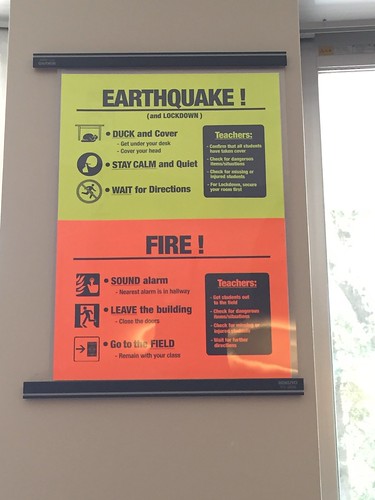
The crisis response manager (and librarian) Nicholas Meyer (namer@nis.ac.jp) of the Nagoya International School was kind to take us on a tour yesterday. He demonstrated the equipment and procedures the school has on campus to respond to an emergency. I like to see what other schools are doing to take good ideas back to our school. It is a goal of mine this year to produce a thorough crisis response manual in English and review it with our community.
The good ideas I got from the tour were to print and post notices of the students with severe allergies (peanuts) or serious medical conditions. A page with their name, photo and grade is posted in the teachers’ lounge and in the business office. This will make it easy for everyone to identify. The other idea was a parent pick-up form (below) that makes it easy for the school to figure out who has left with their parents in case of an emergency dismissal. They also had safety officer vests to identify people in charge. He also mentioned everyone knowing where the gas canisters are located to turn off and a reminder that people may be trapped in the elevator if the power goes out.
One thing to look up when I return is the anti venom for the red-back spider. We have found several red back spiders on campus historically. What would we do if someone gets bit?

Japan Association of IB School Heads Autumn Meeting

On Thursday September 17 I attended the Japan Association of International Baccalaureate (IBAJ) meeting of heads of schools hosted by the Marist Brothers International School (MBIS) in Suma ward, the western side of Kobe.
My big “takeaways” are
- it may be worth our while to explore the CP (Career Related Programme) or at least develop an internship program for our students
- we should also be looking at offering online learning in the DP through Pamoja
There were also many other smaller ideas and feedback I received from the other schools. All in all, a very valuable day for me and our school.
We discussed the following issues:
- MYP E-assessments – No MYP schools in Japan are participating in this program. Practically, they do not offer Japanese language and for 50 students, it would cost $30,000 and it takes place the same time as the IB DP exams. The argument against also is too much testing and the certificate is not worth much.
- Dual Language Diploma – I was confused on how many subjects must be taken in English to earn this diploma. They must take English and one other subject in English as a minimum.
- Learning Support – Schools struggle to find experts and specialists in Japan, especially in English. Remote services (online) are gaining traction especially for speech therapy. There is one specialist in Tokyo that was highly recommended.
- Career Related Certificate – No schools have this IB programme in Japan. Several schools are developing internship programs.
We had video conferences with many key personnel from the IB Asia Pacific Region.
Kevin House – regional head of school services Asia Pacific
- He leads a team of IBEN (experienced IB educators) to help schools with authorization, self-studies and evaluations. School services also manages professional development programs (Base Camp) and facilitate coordinator networks. Kevin’s conversation reminded me of how useful the site can be. I will make a module of useful links on this blog.
- The next IB visit to our association (IBAJ) will be in the spring of 2017. We asked them to give us dates and a venue for this meeting.
Ayumi Hoshino – IB regional development manager of Article 1 (local – prefectural accredited) schools in Japan
- Geography, Visual Arts, Music will be soon released in Japanese language.
- MEXT is issuing special teacher certification for schools hiring foreign teachers. It is a lot of paperwork, but not a difficult process.
- MEXT announced on August 19 a flexibility scheme that made it easier for Article 1 schools to meet the national compulsory subjects and all classes can be in English except Japanese language. Japanese students need 74 credit hours to graduate which is much more than an international school. Hence, Higher Level courses will be worth 10 credit hours each and Standard Level courses worth 6 credit hours each. They still need to earn more credit hours outside of the DP subjects, and MEXT is trying to reduce this.
- The University of Tokyo and Kyoto University will start DP admissions from this winter. Both universities do require students to take the preliminary exam. They do not have to take the individual subject exams, only the basic proficiency exam in Japanese. Hosei University and Osaka City University are also making entry tracks from the IBDP.
- Environmental Studies, Psychology, Self-Taught Language subjects are not going to be accepted by MEXT soon as Japanese subjects because they do not match with the current national curriculum.
A good idea for our schools Faculty Forum to do an activity with Theory of Knowledge (TOK), a special course in the Diploma Programme that really encapsulates the IB philosophy.
Ed Lawless – Employee of Pamoja Education, the sole provider of online/blended learning sanctioned by the IB. He is former head of PD of IB Asia Pacific. Ed gave us the following about Pamoja’s growth.
They are accredited by WASC since 2011 and have moved to In-house course development in 2012. They are growing and currently have 2009 3091 students, 113 teachers and 17 courses. They have courses in all subject groups except experimental sciences. They focus on courses that help schools fill in gaps. They have TOK and ATL integration across all courses. They also have a new LMS (learning management system) called “Canvas“. “Learning Spaces” are forums that students can interact with each other and the teachers. Nice advantage is the four cohorts of 25 students can interact with 4 teachers across the world. The scores of the students are pretty good, with 82% of the students earning a 4 or above. Regarding costs, 25-30% pass the costs on to the parents Good ideas for schools is that if student withdraws, then parents pay for the course and some schools have an application process to earn the right to take an online course.
They are developing school-supported self taught languages and English B. An idea would be to bring all the language tutors in the JCIS schools together so if one school has a good Russian tutor he/she could do all the schools. He said more students are choosing psychology over history. They are thinking of developing a”taster” course 4-5 week pre-IB experience for grade 10 students to get used to on line learning.
I believe that this is an experience we should be giving our students – self-regulated learning environments, because this what students will face in university.
Grates Added in East Parking Lot

We are always concerned about student safety. This weekend, the KG facilities department installed covers for the drainage canals near the east parking lot. This is a high traffic area with the buses loading and unloading, students coming to school on foot and bike, and parents waiting for picking up their children. The grates will make sure no one falls into the canal. The grates have a rough surface to prevent becoming slippery when wet.
I would like to thank the OIS Parent Teacher Association (PTA) for bringing this to our attention and the Kwansei Gakuin facilities department for purchasing and installing the grates.

